

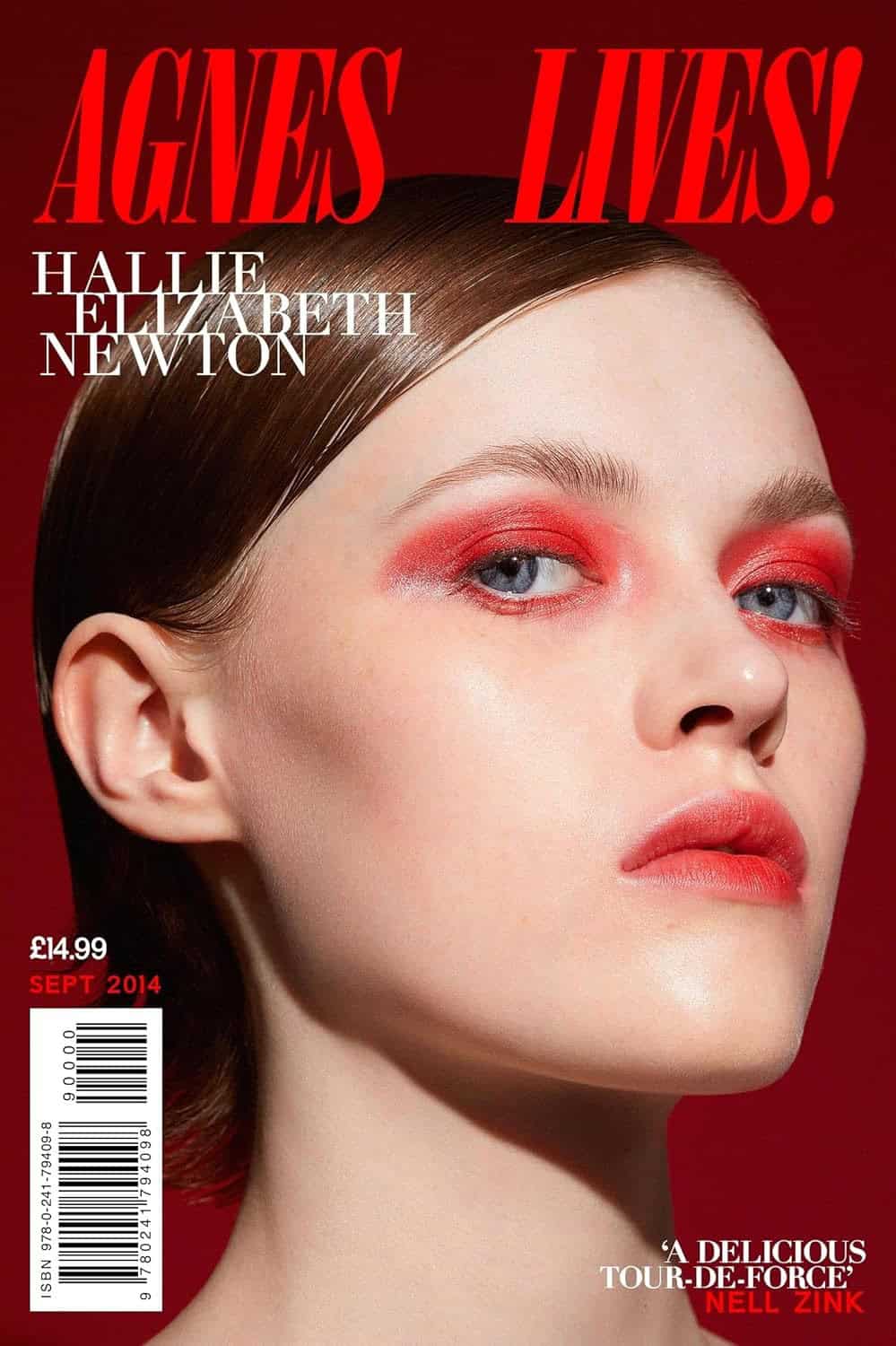
Readers, it’s happened. They’re now writing historical fiction set in the 2010s. For Hallie Elizabeth Newton, author of the electric Agnes Lives, there was no other time or place she could set her debut novel than New York, 2014.
Agnes, Newton’s unforgettable protagonist, is privileged, selfish, funny, and achingly suicidal. Over the course of one day, she moves through New York’s glossy restaurants and back-alley markets, looking for someone to kill her. The goal? To be dead before tomorrow morning’s SoulCycle class.
Set in 2014, Agnes exists in a pre-Trump, pre-COVID, pre-#MeToo New York, when Instagram still felt more like a window into the lives of your peers than a never-ending advertisement. It is also a novel deeply interested in the artistic history of women who want to escape their lives, from The Awakening to Mrs Dalloway and Cléo from 5 to 7.
In my conversation with Newton, we spoke about female friendship, the label of “weird girl literature”, and why a woman who says she wants to die might actually be ravenous for life.
The Cold Magazine (CM): The novel is specifically set in 2014. Why was that moment important?
Hallie Elizabeth Newton (HEN): I wanted it to be before Trump, before COVID, before #MeToo, and before TikTok.
But also before Instagram changed so much. In 2014, if somebody posted something at 9:20, you would see it around 9:21. You followed people you actually knew.
It was a little bit more innocent. Or ignorant, depending on what you consider.
CM: Your novel follows Agnes over a single day. Where did the character originally come from?
HEN: I was in my MFA and I had this idea that I wanted to write a scene where the character’s brain works on the page like it does in real life.
So she’s doing one thing, but she’s thinking about five other things. I started with Agnes shopping at Barney’s. She’s looking at the leather, she’s smelling it, but she’s also thinking about her boyfriend and her brother and whether her mother likes her sister more.
I wanted to write about how people actually think. Everyone has unhealthy thoughts. Everyone has thoughts that aren’t kind to themselves.
Dangerous thoughts, sick thoughts. I think Agnes is just a person who has a lot of those thoughts and is not necessarily hiding them from herself.
CM: Agnes is also an “unlikable” woman in a very specific way. She can be selfish, demanding and cruel. Do you think contemporary readers expect women to be more morally palatable than men?
HEN: I taught Denis JoHENson’s “Fuckhead” story, and my students were always asking me, “Are we supposed to root for him?” And I was like, I don’t know. Do you have to root for him?
I understand that readers want to be entertained and read for certain reasons. If you want to feel good, don’t read Old Yeller or The Grapes of Wrath.
I love a good story with a tidy ending, but I’m curious about unlikable characters. I think they’re interesting. As for Agnes’ privilege, I think you can have everything and still feel invisible.
Agnes has been given so much. She has the schooling, the clothes, the family, the money. She was born on third base. But none of that translates to solid love, and I think that’s something people don’t always understand. You can have a very privileged life and still have a terrible emotional life.
CM: That seems to be one of the central contradictions of the novel: Agnes has access to almost everything, but she can’t seem to access the thing she actually wants, which is connection.
HEN: Yes. She wants to be seen. She wants somebody to do something with her.
Whether that means literally killing her, making a real connection, or somebody saying, “No, babe, don’t do this”. I think that’s what she wants.
CM: So when Agnes says she wants to die, do you believe her?
HEN: I think she believes herself. But there’s a difference between wanting to die and wanting something to change, and there’s something in her that keeps choosing life. She likes eating. She likes New York. She likes frosting. She likes Prosecco.
I think she enjoys life.
CM: Agnes’ eating habits are actually quite important. She has this voracious appetite and, despite being part of this milieu of thin, wealthy New York women, she’s breaking free on this day – what is meant to be her last day on Earth.
HEN: Yes. In an earlier draft, there was this very Grand Guignol scene where she was vomiting in the basement of a restaurant. I took it out because I thought, if it’s really her last day, wouldn’t she eat what she wants?
That’s probably, in real life, a very problematic way to think about things. But for the story it made sense. If you really think this is your last day, why wouldn’t you have the frosting?
CM: She also seems terrified of losing control over her life. Is that part of it?
HEN: Yes. She’s not necessarily afraid of being put in jail. She’s afraid that her father or lawyers will intervene and put her somewhere else.
She cannot not be in New York. New York is very important to her. I think New York can hold you, but it can also discount you.
You can be surrounded by people and still be alone if they don’t understand you. You can be born on third base, have the best schooling and clothes and a charmed adolescence, but that doesn’t translate to solid love.
CM: New York feels fundamental to Agnes’ identity. She’s almost incapable of imagining herself anywhere else.
HEN: She cannot not be in New York. I think New York is a real gift for her. It’s something she was given thanks to her parents’ profession. It’s like a birthright. And New York can hold you, but it can also discount you.
I think New York is close to me. That’s where Agnes was born. If Agnes were born in Ohio, maybe I would have set it in Ohio.
I’ve lived in New York for about 20 years, on and off. I’ve lived in other places, but New York is the place I keep coming back to. I love the women there. I love watching them.
CM: What kind of women?
HEN: There’s a woman I saw recently at Bergdorf Goodman. I was there with my mother and this woman was telling the waiter, “I’m allergic to olive oil. I’m allergic to grapeseed oil. I’m allergic to avocado oil, but not avocados.”
My mother was like, what? And I loved it. I love that kind of New York so much.
Another time I was trying on these gold Jimmy Choo kitten-heel slingbacks, and a woman said, “Those are good.”
I was like, “I don’t know if I can walk in them.” And she said, “I didn’t say that you could walk in them. I said they were good.” I loved that.
CM: Social media is interesting in the novel because Agnes is surrounded by people, her followers and old friends, but still fundamentally alone.
HEN: The deluge of images on Instagram can speak to anxiety as much as excitement. They’re kind of cousins.
You’re constantly seeing everybody else’s life. And Agnes is constantly thinking about other people and what they’re doing and what they think of her.
CM: There’s a long literary tradition of women who want to escape their lives through death. Were you consciously engaging with that?
HEN: Yes, absolutely. There are so many tropes where a woman needs to be free, therefore kills herself.
The Awakening is a big one. Butterfield 8. Thelma & Louise. The woman can’t live in this world, she has to be free, and then she walks into the ocean or drives off a cliff.
I remember being upset when I read The Awakening because I thought: why doesn’t she see other options? There was an older single woman who taught piano. Why couldn’t Edna have been that woman?
Why does the woman have to die?
CM: That seems especially relevant to Agnes Lives, because Agnes has options that many of these women historically didn’t.
HEN: Yes, exactly. Agnes has so many options and yet she feels like she doesn’t.
I think that’s part of what makes her interesting. She has the ability to make a different life, but emotionally she doesn’t know how to imagine one.
CM: You’ve also mentioned Cléo from 5 to 7 as a point of comparison.
HEN: Yes. I love that movie.
I did a talk with my editor at a movie theatre and we showed parts of it. It’s about this pop star in Paris who is told by a tarot reader that she’s going to die. Then she spends hours walking around Paris.
She keeps saying that she doesn’t want to die.
I wasn’t consciously thinking about that when I wrote Agnes Lives, but I think there’s something there. A woman saying she wants to die and a woman saying she doesn’t want to die can actually be very close together.

CM: Agnes also has a complicated relationship with her best friend, Moonhour. There’s a queer angle there, and a suggestion of romantic and sexual history between them. How did you think about their relationship?
HEN: They kissed when they were teenagers. In the novel, Agnes watches Moonhour through a window with another woman, and there’s this whole history between them that isn’t necessarily defined.
I think sexuality is fluid. Especially when you’re young and there are fewer risks, there’s an allure to experimentation. Moonhour has relationships with men and women, and I didn’t feel like I needed to put a label on it.
CM: That refusal to define sexuality feels very different from some contemporary queer fiction, where identity categories can become central to a character’s story.
HEN: I think sexuality can just be part of somebody’s life. It doesn’t have to be the entire story. And I think that’s realistic.
CM: The novel has been described as “weird girl literature”. What do you make of that label?
HEN: I don’t even know what it means, really, but I’m happy to be invited to any party. Weird girl lit is a pleasant place to be, I have to say.
But I do wonder what we’re saying when we call it that. There was such a period of “The Girl with…” books, and then “girlboss”.
We’re defining these women who are doing dangerous things – being a spy or an assassin or a special op – and we’re infantilising them to make them more accessible, or less threatening.
CM: Your literary influences are much broader than contemporary “weird girl” fiction. Who were you thinking about while writing Agnes?
HEN: Mrs Dalloway, obviously. Someone described the book to me as “a fucked-up Mrs Dalloway of our time”, and I loved that.
Philip Roth’s Sabbath’s Theater, Portnoy’s Complaint.
Martin Amis’s London Fields. Martin was one of my professors.
And I think there’s a tradition of writing women who are difficult, women who are sexual, women who are not necessarily trying to make themselves palatable.
CM: Your background in screenwriting seems relevant to the way the book moves almost cinematically through New York.
HEN: I think so. I like watching people. I like watching a character move through a space and seeing what happens to them.
New York gives you so much of that. You can be walking down the street and see something completely insane happen, and then you just keep going.
CM: That’s part of what makes the novel feel realistic, despite some of the more extreme things that happen to Agnes.
HEN: Exactly. I think this is kind of a very realistic book.
A lot of these things could happen. You’re in a city, you see such crazy stuff happen in a city, and nothing really happened, you know? The city keeps going. Weirdness is part of life.
CM: How do you feel about Agnes now that she belongs to readers?
HEN: I’m happy I got to write her. And I’m happy that it’s been met with very smart humans have said nice things about it. So I’m happy. I’m happy to be invited to the party.
Agnes Lives! by Hallie Elizabeth Newton was published in the UK by Viking Penguin on 27 August 2026.


