
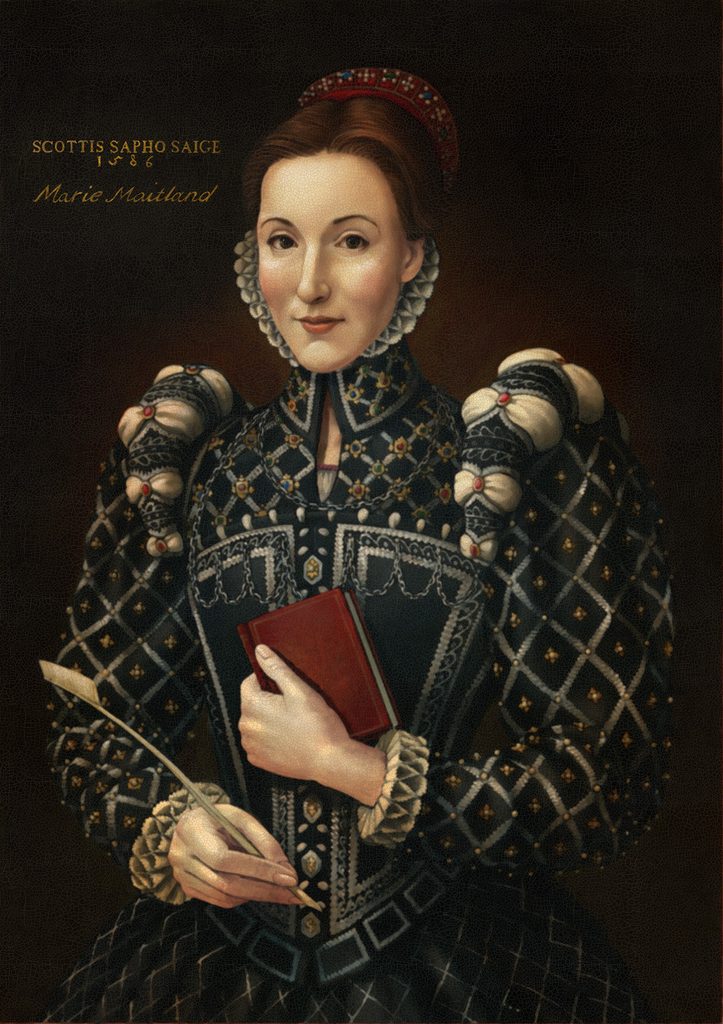
Long before Anne Lister was born on the hills of Halifax or Gertrude Stein came screaming into the world along the river valleys of Pennsylvania, there was Marie Maitland. This Scottish poet of the 1500s was the daughter of an influential judge, poet and Keeper of the Privy Seal under Mary, Queen of Scots. She was also a lesbian.
While her elder sisters were married off one by one, Marie stayed behind. And when her father went blind, Marie took up the role of scribe and secretary, allowing her a rare sense of freedom as a woman in the Renaissance age. As she transcribed the Maitland Quarto, a powerful poetry anthology featuring the works of the male great-and-good of sixteenth-century Scotland, Marie secretly included her own verse and that of other women in her circle.
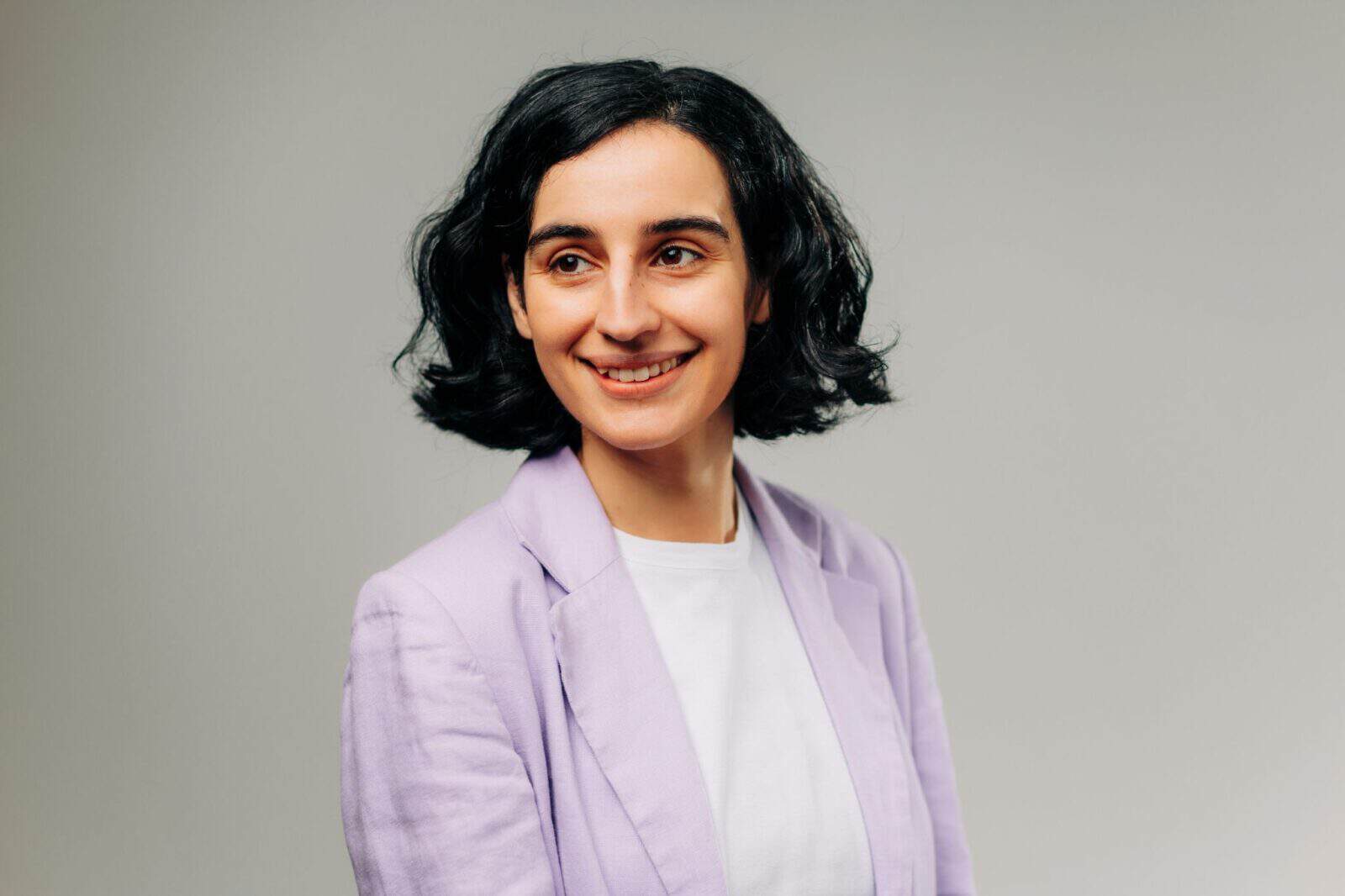
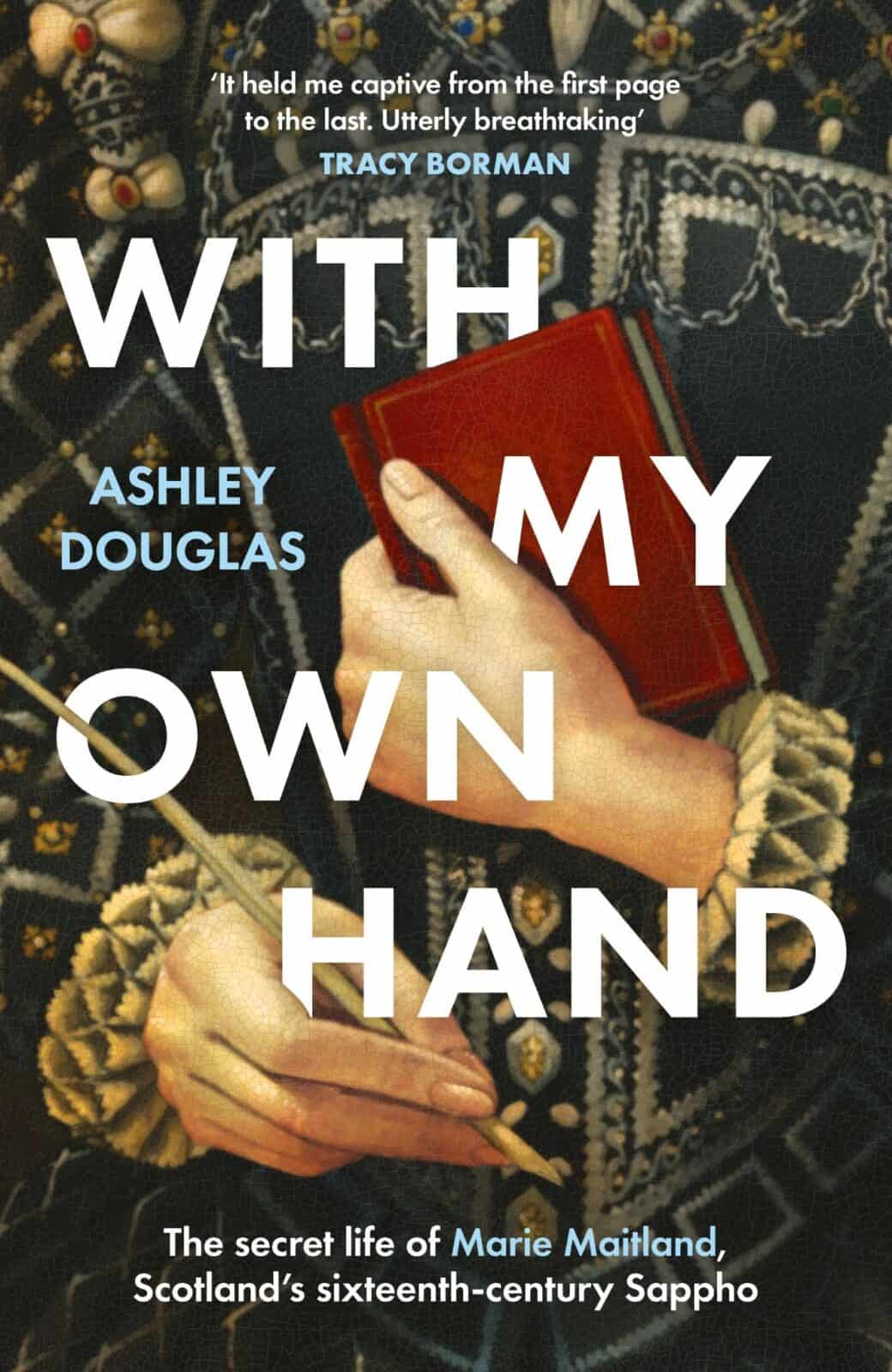
In her new book, historian and Scots translator, Ashely Douglas, unravels the story of Marie Maitland’ secret lesbian love poetry, and even hints at a potential love affair with a fellow noblewoman. In With My Own Hand: The Secret Life of Marie Maitland, Scotland’s Sixteenth-Century Sappho, Douglas takes us through the dangerous years of post-Reformation Scotland and breaks open the lesbian pantheon – adding one more fierce writer, devoted daughter, and proto-feminist icon to its ranks.
The Cold Magazine (CM): What’s the origin story of the book? How did you discover Marie Maitland and the Maitland Quarto?
Ashley Doulgas (AD): It was a happy accident. I was researching Scots language history for the National Library of Scotland, looking at significant historical Scots texts, and working my way through the timeline of the language.
I was aware of the Maitland Quarto manuscript, which is well known in academic circles. If you’re a Scottish historian or work in Scottish literature, you’ve probably heard of it. But as far as I knew, it was a manuscript containing poetry by men: Richard Maitland, King James VI, and various other male poets. So in around 2020, I went to the National Library to look at a later printed edition of the manuscript, because the original is in Cambridge.
Little did I know how significant it would become. When I opened it, I saw a woman’s name twice emblazoned on the front page: Marie Maitland, 1586. I immediately thought, Who is this? What is this about? I didn’t know there was anything to do with a woman.
Then, as I read through the manuscript, I found more than 30 anonymous poems. So many of them immediately struck me as being by women, about female themes, and written in a female voice. And I certainly wasn’t expecting to find lesbian love poetry.
CM: Did you begin writing the book immediately?
AD: From that moment onwards, I started writing about the manuscript, Marie Maitland and Poem 49, which is one of the most explicit lesbian poems. It’s the first one I encountered chronologically, and I immediately recognised its significance. This is the 1500s; this is Reformation-era Scotland. It’s astonishing.
At the same time, I was thinking: Who is this woman? I need to know everything there is to know about her. And there was very little out there. The book is the first time her story has ever been told, and it’s based on loads of brand-new records that nobody had ever gone looking for before.
I very quickly exhausted what little information existed about her. There was a short entry in the Oxford Dictionary of National Biography and occasional mentions in anthologies, but they were often only a few sentences long – and, as I discovered through my own primary research, sometimes inaccurate.
CM: One of the things I loved about the book is the way it brings together strands of history that are often treated separately – women’s history, queer history and mainstream Scottish history. Did you feel any anxiety about how more conservative historians might respond to that?
AD: I’m not writing for them.
I’ve chosen to write a mainstream book, rather than an academic book. That was one of the first decisions I had to make when I was developing the proposal.
I think in academia there can sometimes be a lot of unnecessary hand-wringing – discussions about terminology and definitions that can become a distraction. If you find these stories in the archives and literary manuscripts of the 16th century, how is an average 21st-century queer woman in London, or anywhere else, meant to encounter them?
If I’d written an academic article containing exactly the same material – here are these poems, here’s this manuscript, here’s Marie’s life – it could have been the same in terms of content, but the book would have been prohibitively expensive, and the people I actually want to read it would probably never have encountered it.
Ultimately, it’s for women who love women. It’s for anyone interested in the story, of course, and I think it’s a good story in its own right. But particularly for women who love other women: how are we meant to know our history if it’s not shared?
CM: You mentioned terminology. You’re very careful throughout the book not to describe Marie as a “lesbian”. Why was that important to you?
AD: I’m very careful never to use a term that Marie herself wouldn’t have recognised. I don’t describe her as a lesbian or queer. I describe her as a woman who loved other women, which is a fact. I sometimes describe her as sapphic, and that’s a term that she would have recognised.
In Poem 85, she’s literally compared to Sappho. The poem describes the “sapphic song” as being so sweet.
It’s a two-pronged approach. On one hand, I reject the premise that we need to get completely bogged down in terminology. I want to find LGBT histories and tell them in an accessible, meaningful way to a modern audience.
But I’m also aware that some people will approach the book in bad faith and immediately look for anachronistic labels. So, as a concession to that, I’ve been very careful never to ascribe a modern identity to Marie that she wouldn’t have recognised.
CM: The book also contains a lot of interpretation, because there are gaps in the records – particularly around the circumstances of Marie’s death. How did you navigate the line between what the evidence tells us and what you might reasonably infer?
AD: For the most part, the book is firmly rooted in the records, and I really tried to steer away from speculation. Her death is probably the main place where I had to go beyond what’s explicitly recorded.
My conclusion is that she most likely died in childbirth, but I make it very clear that I’m not stating that as a fact. I explain what the records say and, with our knowledge of 16th-century women’s lives, why that conclusion is likely.
When I go further than what’s strictly in the records, I make that very clear. The result is as objective as you can be.
And when it comes to the lesbian love poems, I don’t think there’s any reading between the lines required. Sometimes LGBT historians talk about “queering” the past or “queering” history, but that’s really not what’s going on here.
The analysis of Poem 49, or of a poem comparing Marie to Sappho, doesn’t require you to read it through a queer lens. The records simply tell us that this is a woman who loved women and that other women compared her to Sappho.
CM: So you would say that this isn’t a case of “queering” history, but simply telling history as it was?
Ashley: Completely. I think it’s really important to distinguish between those things. I know people are well meaning, but I’m not sure it’s always helpful when people talk about actively “queering the past”.
To me, it’s the wrong message. You don’t have to actively queer history. There are people who loved people of the same gender in history. They just existed.
When you have a woman writing a poem to another woman saying that she wants to marry her, and you read that as, “Well, perhaps they were just good friends”, that’s interpretation. That’s what I would call a heteronormative interpretation.
So I’m not reading the past through a queer lens. I’m removing the veil – the heteronormative, homophobic veil – to see what’s always been there but has been clouded.
CM: There’s a particularly beautiful moment in the book where you talk about reading Marie’s desire to marry another woman while looking down at the page and seeing your own wedding ring. What did marriage mean to you as you were researching her story?
AD: It’s massively personally meaningful. It’s such a validating connection.
My marriage to my wife is the best thing that’s ever happened in my entire life. When you’re madly in love with somebody, you want to solidify that. You want to proclaim it as publicly and as completely as you can.
So it’s very clear to me how in love Marie was. When you really fall in love with your person, you want to do everything in your power to scream that and formalise it. That’s what she wanted to do.
As a woman who has experienced those emotions myself, I felt very connected to her and could completely understand that.
And I think it’s also important that equal marriage in Scotland had only been legal for three years when my wife and I got married. That’s harrowing. Only three years.
When people debate whether same-sex couples should be allowed to marry, there’s often an appeal to tradition: It’s not traditional; it’s not the way things have always been. And having a woman from more than 400 years ago expressing those same sentiments gives the lie to that notion.
Women have always fallen in love with other women and wanted to formalise that love through marriage. It’s not some new, modern thing. Marriage is an ancient institution, and if that’s the way love was formalised in Marie’s world, then it’s natural that this was what she wanted.
CM: Another aspect of Marie’s story that I found fascinating is her relationship with religion. There’s a tendency to frame homosexuality and religion as being fundamentally in conflict, but Marie seems to complicate that completely.
AD: I think that’s a massive misconception: that the church or religion and homosexuality are inevitably in conflict.
There’s this idea that gay people today are trying to change the church or bring the church with them, when actually Marie Maitland’s story shows that people of religious faith who also loved people of the same gender have always existed.
There’s no doubt from her other writings that she was a sincere and convinced Calvinist. And yet she combines that sincere Calvinist faith with her intense sapphic love for another woman. She doesn’t see those things as being in conflict. In fact, she appeals to the Bible to validate that love.
The idea that this is a new problem is challenged quite powerfully by Marie. Here is a woman from post-Reformation Scotland, living at the time of John Knox and Mary, Queen of Scots, who is a Presbyterian and who validates her sapphic love with reference to scripture.
CM: What do you think are the biggest misconceptions people have about queer life – and about 16th-century Scotland more generally?
AD: The biggest one is that gay people are somehow a modern phenomenon. They absolutely existed in 16th-century Scotland, just as they have in every century of Scottish history, and indeed in every country in the world.
As long as there have been humans, there have been humans attracted to people of the same sex or gender. That’s a fact.
And 16th-century Scotland is actually quite a powerful period for examples of LGBT people. We’ve got King James VI, who is arguably the least heterosexual monarch in British history, and he’s part of Marie’s context. Earlier in the 1500s, we have Lord Darnley and David Rizzio, who were surrounded by rumours about homosexuality.
So the idea that anything other than heterosexuality is new or modern is completely blown out of the water by 16th-century Scotland.
There’s also the important point that absence of evidence is not evidence of absence. The people we have records for tend to be elite figures, including Marie, James and Darnley and Rizzio. That obviously doesn’t mean there weren’t same-sex attracted people among the lower classes. They may simply have left no records, because they couldn’t write, or because nobody wrote about them.
CM: You’ve also done an enormous amount of work with the manuscript itself. Can you talk about the process of reading and translating these historical documents, particularly Marie’s cursive handwriting known as secretary hand?
AD: There are several modern print editions of the Maitland Quarto, so I wasn’t starting completely from scratch with the manuscript itself.
The more challenging and time-consuming work was with the new records about Marie’s life, because those had never been transcribed before. They only existed as documents written in secretary hand.
So it’s a two-stage process. First, you transcribe the secretary hand into modern Roman script. Then you translate the historical Scots into modern English. It’s a huge amount of work when you’re dealing with primary records.
It’s almost like deciphering a code.
I ended up running my work past five different historians. We were all staring at these words, trying to work out whether a particular mark was a G or something else. You need that kind of team around you when you’re transcribing documents that have never been transcribed before.
CM: On the topic of making Marie’s story accessible to modern audiences, how do you think her writing is relevant to women living in Scotland in 2026?
AD: We have always been here. Women who love women have always been here. Marie is a case in point for Scotland, but her story is also completely universal.
For me, Edinburgh is my home city, so it’s extremely powerful and validating to be walking the same streets as Marie. The historical core of Edinburgh has changed remarkably little. From the Royal Mile to St Giles’ Cathedral, she would still know exactly where she was if she came back today.
When I’m walking around the city now, I’m always thinking about that. Marie walked along the Royal Mile, past St Giles. She had her house here, near Arthur’s Seat. She would have looked at the same crags and the same volcanic landscape that I see. Her eyes saw the exact same things.
Before I came across Marie Maitland, I didn’t know of any women in Scottish history like me – a woman who loved another woman – where we had such a clear historical record. I knew women like that had existed, obviously, but I didn’t think there was a particular person I could identify with or lean into.
And now I’ve got one. I hope that will be the same for other Scottish women, but also for any woman who loves another woman.
CM: If you could bring Marie back to life and speak to her, what would you ask her?
AD: This was such a fun question. I’d definitely want to ask her: Who was your lover?
That’s the tantalising thing I just could not dig out of the archives. There are still avenues to explore, but it was impossible to identify her for this book. Obviously, she existed. She was somebody of Marie’s status – somebody educated, beautiful, extraordinary. But who was she? What was her name? How did they meet?
And that goes back to the question of interpretation. I don’t know these things, and I didn’t pretend to. I didn’t invent them. I just said: we don’t know. We know that Marie and this woman met at some point. We know that they fell madly in love. But we don’t know how they met or what happened to their relationship.
I’d want to ask: Did you ever hear from her again? How did it fall apart? I want the full drama. I want to know what was going on in that situationship.
CM: Exactly. You’d need to make her listen to a Chappell Roan song.
AD: Exactly! And I’d also want to ask where Marie was buried. That’s another thing I tried really hard to find in my research, and I just couldn’t get the answer.
CM: It’s exciting to think that, through your work, Marie is now known – and that future historians might eventually answer some of these questions.
Ashley: That’s exactly it. I’ve put her name and her story out there for the first time, and who knows where that goes? If somebody else working on this period comes across something, they’ll know who Marie is and hopefully they’ll share it.
I’m hoping that if Marie gets enough recognition, she’ll become like Anne Lister. If somebody researching eighteenth- or nineteenth-century England comes across a reference to Anne Lister now, they’ll probably think, Oh, is that the famous person? That recognition didn’t exist before her profile grew.
I’m hoping this is the first step for Marie. I’d love other historians to take her story further. If you’re a PhD student looking for a topic, please go and find out who her lover was. Go and pour over all those records and tell me what you find.
CM: So what’s next for you after With My Own Hand?
AD: I’m more excited about what might come next for other people. I hope what I’ve demonstrated with this book is that there are LGBT histories in the archives that have not been sought out yet and have not been shared yet.
We need to go back to the archives and the primary sources because Marie’s story shows that these records can be sitting there in plain sight for centuries.
The Maitland manuscript is right there. Generations of academics have engaged with it. The records of Marie’s life are in major Scottish historical sources – the Register of Deeds of the Court of Session, the records of the Privy Seal. These aren’t obscure documents. These are records historians have been working with for generations.
So if Marie can have been overlooked for all this time, what else is there?
There will be other stories. Not just in Scottish archives, but in English archives, American archives, everywhere. I’m absolutely positive there are other Anne Listers and Marie Maitlands waiting to be discovered.
I’m more excited to see what comes out of that – what other people hopefully feel empowered to go and find.
Go find your own Marie Maitland. Go get them out of the archives, because they’re there.
Ashley Douglas’ With My Own Hand: The Secret Life of Marie Maitland, Scotland’s Sixteenth-Century Sappho was published by Headline Press on 16 July 2026.


