
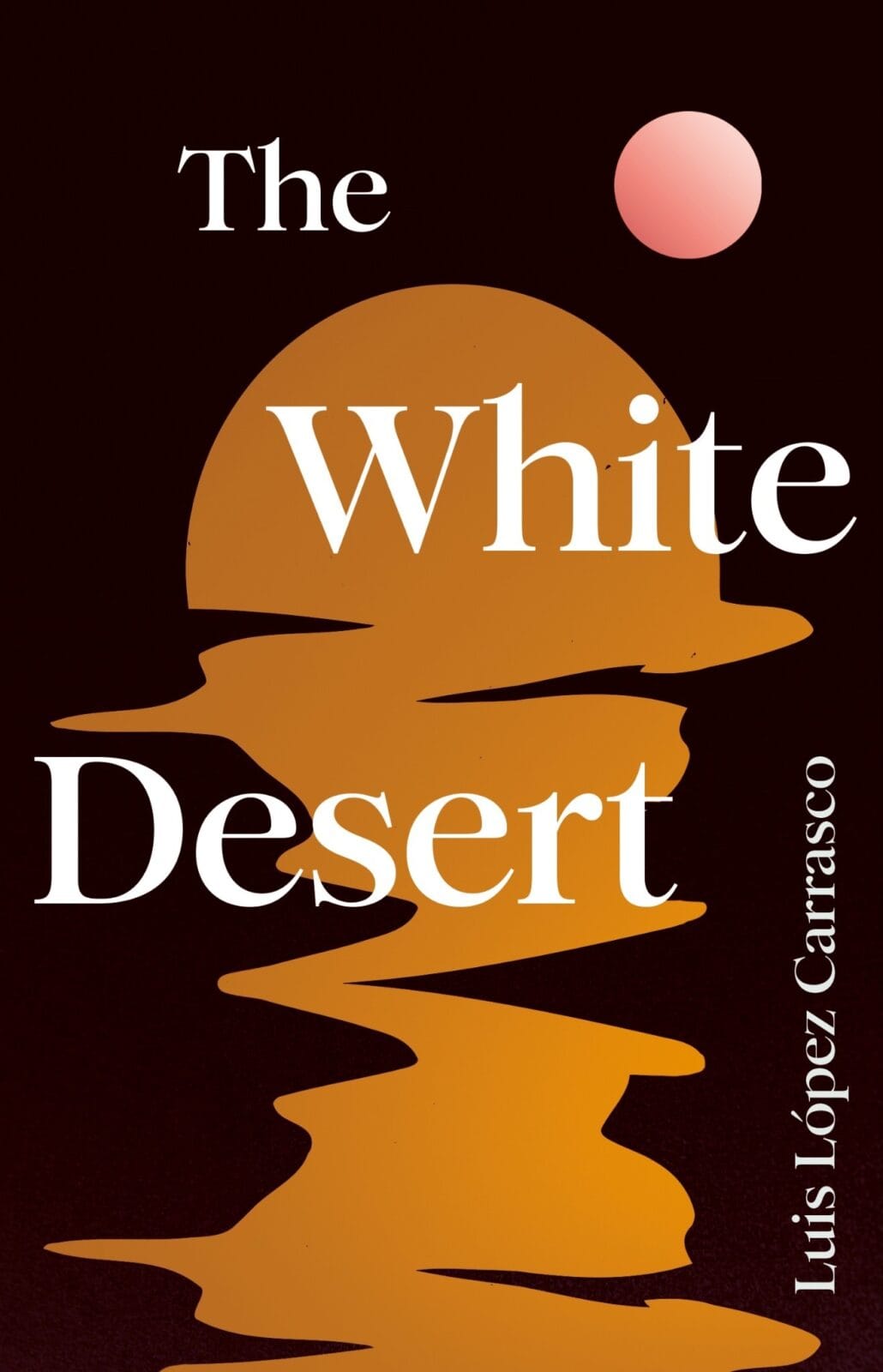
When reading The White Desert by Spanish writer and filmmaker Luis López Carrasco, my mind wanders to images of the apocalypses I hold dear. I think of the snowy landscapes of The Thing (1982) or the plane crash from Lost (2005). When The White Desert opens, the apocalypse is old news, leaving readers to fill in the blanks. Disaster by ice? By fire?
We’re unsure what, exactly, has happened, or where our protagonists, long-time couple Carlos and Aitana, have found themselves. But things are okay. They are sharing five stories from their past in a mosaic of tales touching on family, friends, work, and even a plane crash. Yet, as readers look for clues to understand what might have happened, Carrasco holds back, suffusing the novel with an air of post-disaster mystery.
In conversation with The Cold Magazine, the author speaks on his slanted approach to the post-apocalyptic novel, of his cinematic experience and inspirations, and hopeful possibilities for the future.
The Cold Magazine (CM): I’m interested in the structure of the book. It feels almost like five short stories. I’d also love to hear about your choice to make it a somewhat dystopian novel, while still keeping it rooted in contemporary reality.
Luis López Carrasco (LLC): The idea for the book started with an image: two people who can see each other every night, but who are very, very far apart. They can see one another, yet they can no longer meet.
I wanted to write a novel that ended with that moment: these two characters looking at each other across an impossible distance. So for the rest of the year, I developed a structure that would lead to that scene. The novel has a kind of puzzle logic. Although it may feel like a collection of stories, I still see it as a novel. I had previously written a book of science-fiction short stories, but with this book the entire structure was planned from the beginning.
I was planting small details throughout, knowing they would eventually connect. The experiment was that almost all the pieces would fit together in the final pages. The second part was finding the narrators’ voices. I wanted readers to have to figure out not only where the narrators are, but also when they are. Once I decided that the narrators – and later the brother as well – would be speaking from the future, everything began to come together.
CM: The novel begins with a game, where Carlos is asked to role-play being in a sinking balloon with other job applicants, and they must debate over who gets sacrificed overboard. Throughout the book there are also simulations, role-playing games like Werewolf, and of course video games. Why did you return to this theme of simulated lives and games?
LLC: Sometimes I’m not even aware I’m including these things because I’m simply writing about situations that have surrounded me. I played a lot of video games as a teenager, and I realised I have a familiar relationship with virtual spaces. For me, they’re not necessarily less real than reality, they’re another extension of daily life.
At the same time, I was interested in role-playing games and the fictions we allow ourselves to inhabit. Through role-play, you can become someone else. You can be cruel in ways you wouldn’t otherwise be. I was thinking about the kinds of fictions that surround us.
There’s also the role-play exercise at the beginning of the novel – the one used in a low-wage job interview. That’s actually the only autobiographical part of the book. The novel is very personal, but it isn’t autobiographical. However, that specific experience happened to me while I was looking for work in a shopping centre bookshop. The interview unfolded exactly like that. People became competitive, almost aggressive. There was this underlying idea that you had to “kill” somebody to get a job. It made me think about the kinds of fictions that human resources departments use to introduce competition among workers. There’s a lot of ideology embedded in those exercises.
At the same time, the book reflects on dystopian television series that can only imagine the future through catastrophe. I work as a screenwriter, and I was constantly being asked to imagine survival scenarios and post-apocalyptic worlds. I became interested in the idea that perhaps we should allow ourselves to imagine something beyond survival. What is the place of imagination today? That became a central question for the book.
CM: How does filmmaking influence your writing, or vice versa?
LLC: It’s common to assume that being a filmmaker influences the way you write, but I don’t really feel that way. Since I was about twenty, I decided that fiction would be developed through literature, while cinema would be reserved for nonfiction or experimental work.
Of course there are references to films and screenwriting in the novel. There’s the brother who films his surroundings, for example. But when I read novels, I’m interested in how information and emotion are conveyed through words. That’s what fascinates me.
Some members of a literary jury once told me that both my films and my books are concerned with connecting different times. You’re never entirely sure whether you’re in the present, the future, or even the past. Maybe that’s a common thread. Sometimes I read fiction to prepare for making films, particularly in terms of structure. But I don’t consciously think of my novels as cinematic. If you read Tolstoy, for example, his descriptions can feel very cinematic, not because they’re like films, but because they’re dynamic.
CM: One thing that struck me was how important landscape is in the novel. Could you talk about that?
LLC: Those landscapes are very close to me. They’re the landscapes of southeastern Spain, where my family comes from. Sometimes all I needed to do was remember them, or walk around near my parents’ house.
It’s a very arid, almost desert-like place. As a child, I used to play in those deserts imagining that I was on another planet. Mars, the Moon, outer space – they were all connected in my imagination to the desert landscapes of my childhood.
CM: It’s interesting because those earthly places often feel unearthly. Yet, by the end of the novel, we don’t really get descriptions of where the characters end up.
LLC: I think that’s because I was asking why the narrators are writing in the first place. Perhaps they’re more interested in using writing as a way of travelling back in time and preserving important memories. Maybe they don’t like their present reality enough to write about it. Writing becomes a way of escaping their current situation.
CM: Speaking of the narrators, why did you choose to tell the story through a love story?
LLC: I felt too comfortable with the main narrator. I didn’t want his perspective to dominate the entire novel because I don’t think he fully understands everything that’s happening.
That’s why Aitana appears midway through the book. She brings a different perspective – not only because she’s a woman, but because she may be aware of different forms of inequality. She also comes from a working-class family, whereas the narrator comes from a middle-class background.
I’m a man whose parents are doctors. I’m middle-class. It’s important for me to acknowledge those privileges and limitations. Aitana’s voice was necessary because I think books and films should include social differences and different experiences of reality.
The novel is also about living in a world that feels fully mapped and explained. With smartphones, the internet, and digital technologies, it often feels like there are no unknown places left. Globalisation and capitalism have named everything.
So there’s a tension between living in a world that seems impossible to change and trying to imagine alternatives. That connects to the love story as well. One of Aitana’s fears is that she knows her partner too well. He has no secrets left. He’s become transparent. Maybe he can no longer surprise her. I think she needs to forget certain things because she’s afraid of making this journey with someone she knows too completely.
Luis López Carrasco’s The White Desert, translated into English by Rosalind Harvey, was published by Granta on 4 June 2026.


