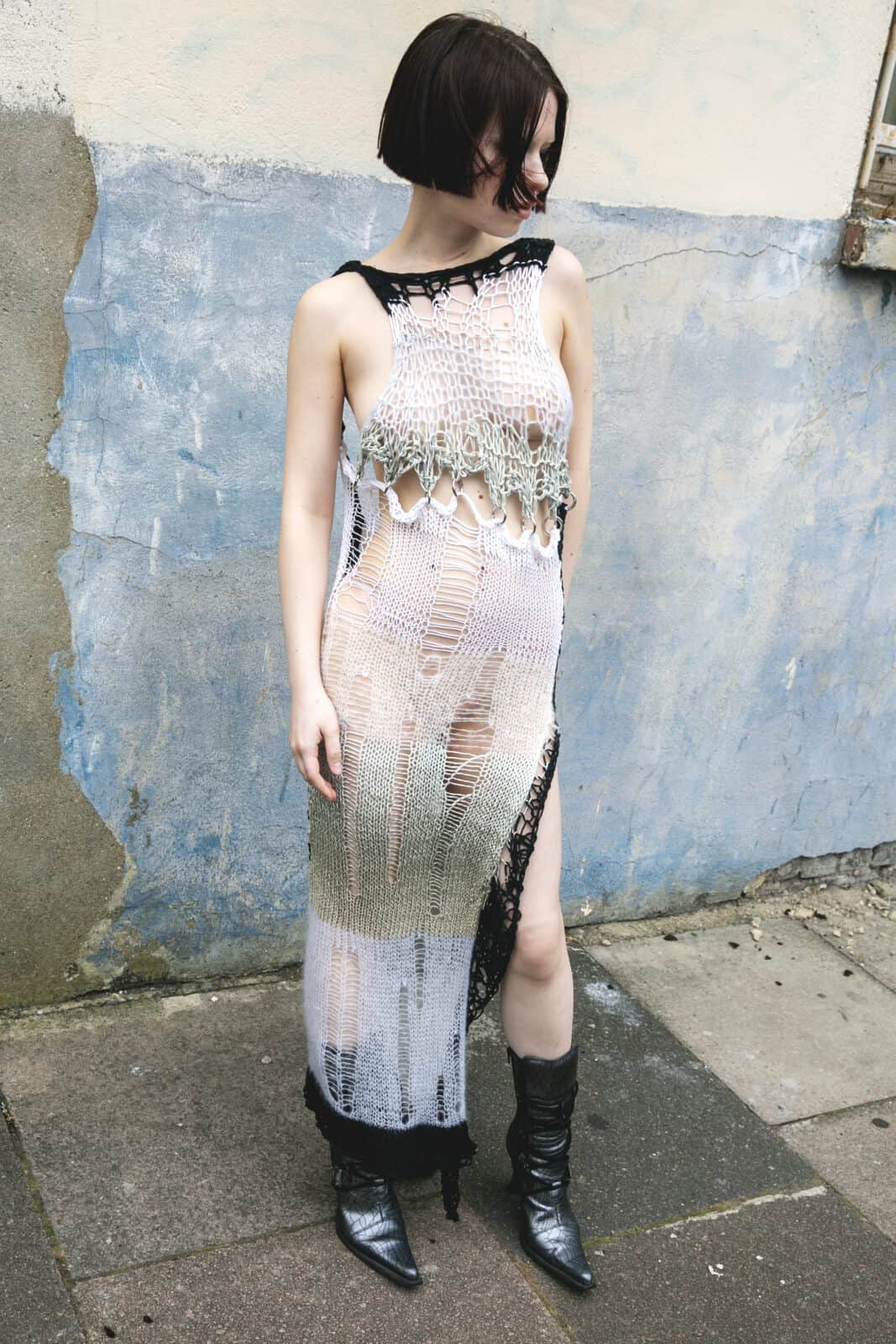
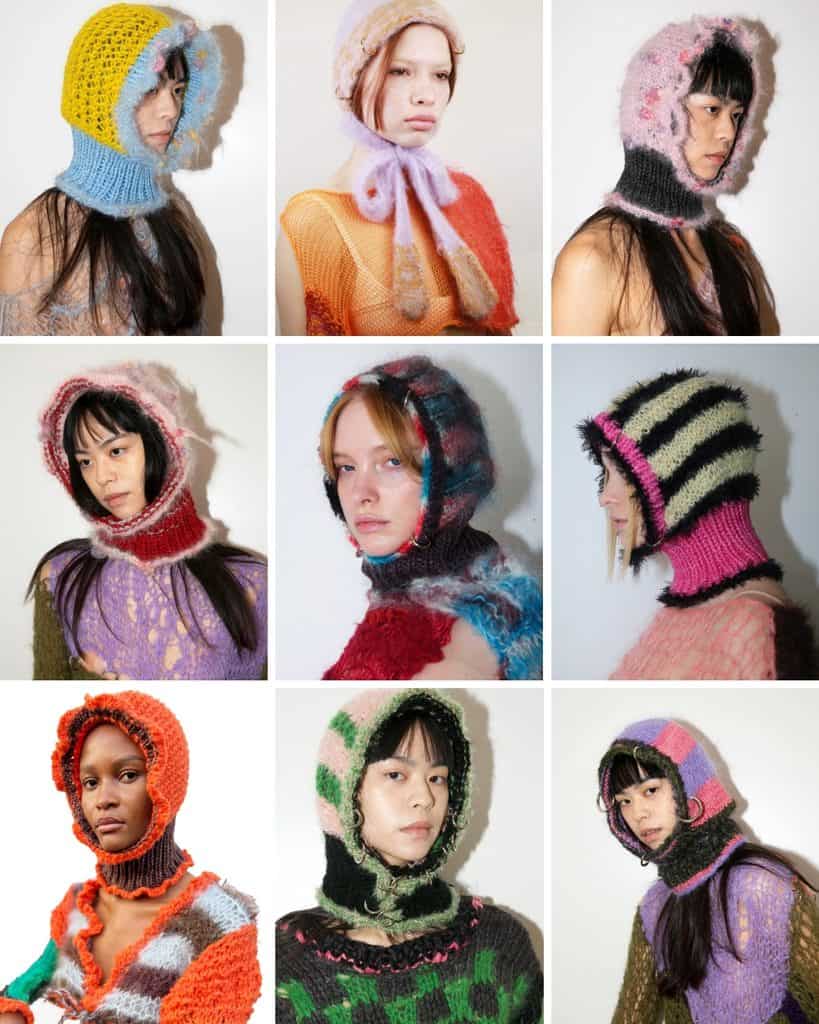
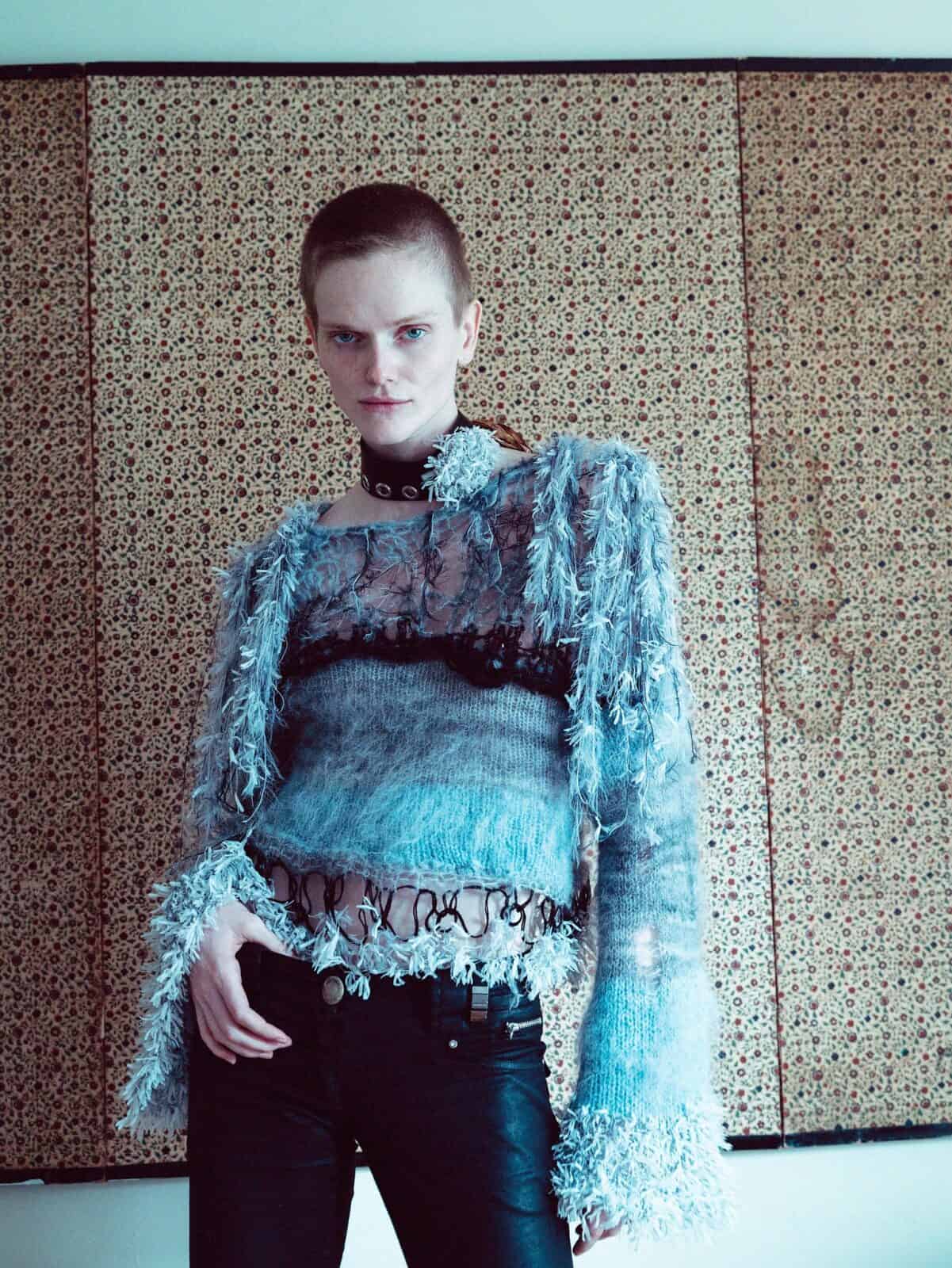
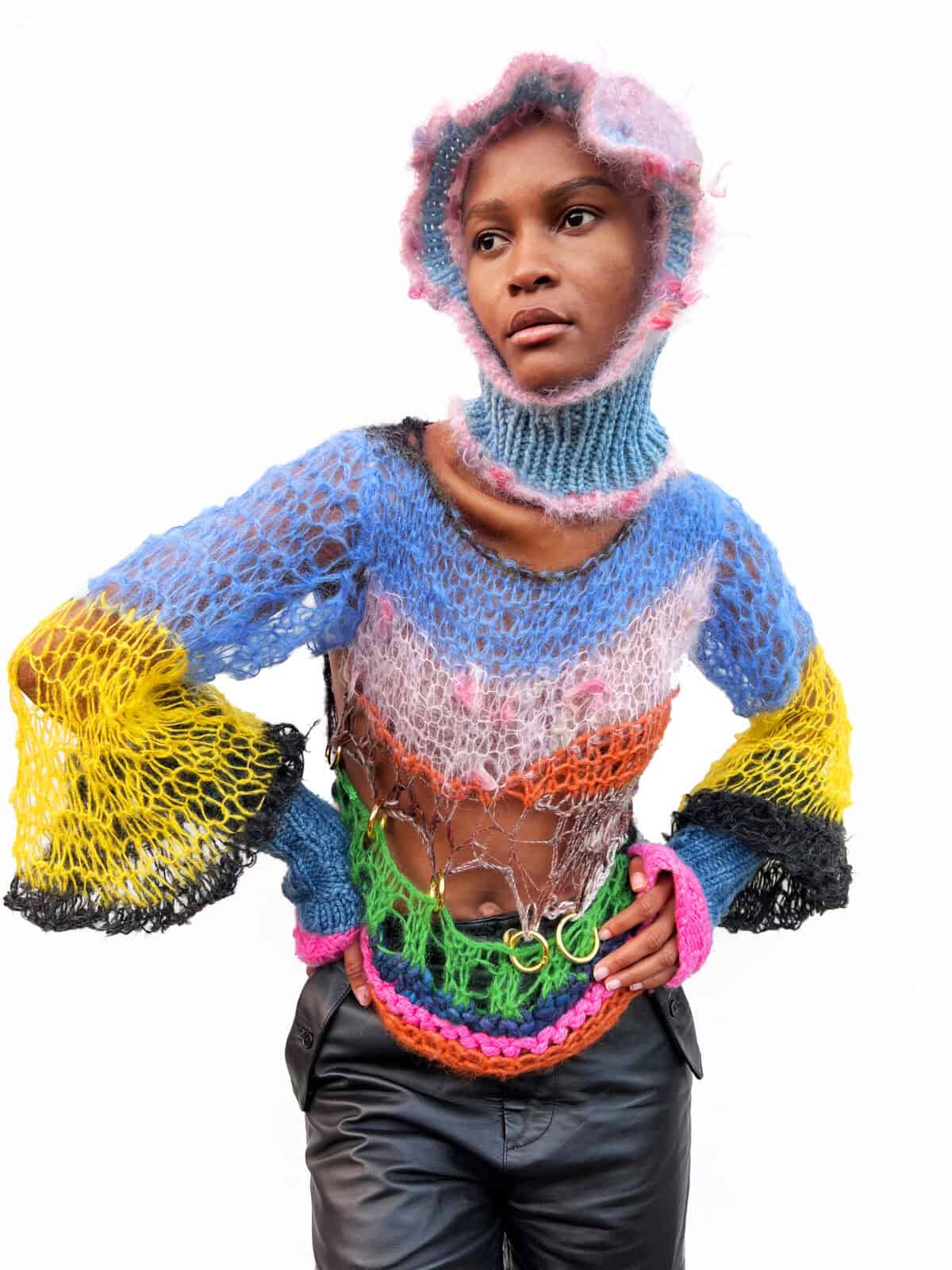
Behind SULK knitwear’s visceral, punky designs is Sarah Beasley. A graduate of Animal Behaviour Science, it was lockdown, and her mother, that introduced Sarah to knitting. Within a year, in 2021, Sarah’s fiendish skill with needles and mohair had given birth to SULK. Her entirely hand-made designs quickly attracted a feature in Vogue+ and celebrity clientele, from pop-rock royalty Sky Ferreira and Fontaines D.C., to Kesha and Rita Ora. Last year, she created custom knitwear for Emily Ratajowski’s character in Lena Dunham’s show Too Much, and made costumes for Billie Piper in I Hate Susie Too. While her designs are indebted to Westwood and McLaren, her work is more Punk Rock on Acid: nose rings link panels of denim or leather to oversized, gaping sleeves; balaclavas grow frills; teacosies become bras. The way she uses colour and texture, you’d think her wool had been left to brew in nuclear waste, and yet somehow, it’s also freakishly sexy. Sarah talks to Cold Magazine about her work, her love of horror movies and making clothes with her mum.
The Cold Magazine (CM): Can you introduce yourself to our readers Sarah?
Sarah Beasley (SB): Hi, I’m a 37-year-old, living in North London. A knitwear designer with my own brand, SULK, which I run from home with the help of my lovely mum.
CM: Before you discovered knitting, what were you up to? Did you have a different creative outlet?
SB: Yes, I was a freelance fashion and music photographer for a while! I also made paper collages for fun. I got a little bored of them, though, and didn’t realise at the time I was craving a new creative outlet! I only discovered I was artistic later in life. I did an Animal Behaviour science degree and picked up a camera in my second year. Creativity wasn’t really encouraged at school, I didn’t associate with that identity. I still weirdly don’t associate with it. I suppose you could call it imposter syndrome?
CM: What got you into knitting? What was the first thing you made?
SB: I’d just moved back to Swansea with my mum, where I grew up as a teenager, to dodge COVID, and ended up staying there for 18 months. While I was there, she asked if I wanted to learn to knit; she’s been knitting for decades. I wasn’t particularly fussed at first. I made a couple of scarves to pick up the basics, and then she showed me how to read a knitting pattern to make my first jumper. I absolutely hated knitting patterns. So I just started remembering how many stitches each size needed on each needle, and winged it freehand from there. I think she was a bit horrified – that’s not really how people do things, making it up made no sense to her! I made some genuinely awful things at first, working that way. But the trial and error is what worked in my favour, and it’s what shaped my signature distressed style.
CM: How have you found the progression from knitting as a lockdown hobby to launching your own brand?
SB: I wasn’t really thinking in terms of making a brand. When I started, it was just a creative outlet to pass the time, which combined my creative skills. I made about 8 pieces, found a model and photographed them myself. I’d had a vintage shop online once, so I knew how to set up a store. I designed bespoke graphics and packaging on Photoshop myself, as there was no budget for help. It was a fun little project initially. Then I almost sold out after launching after a week or so, stylists were emailing me left right and centre, I had my clothes in a Vogue+ editorial, was asked to do a workshop at Tate Britain and made costume for a TV show dressing Billie Piper called ‘I Hate Suzie, Too’. This was all within a matter of months. So I thought, let’s do this.
CM: Can you talk me through how a new piece comes about, what your process is?
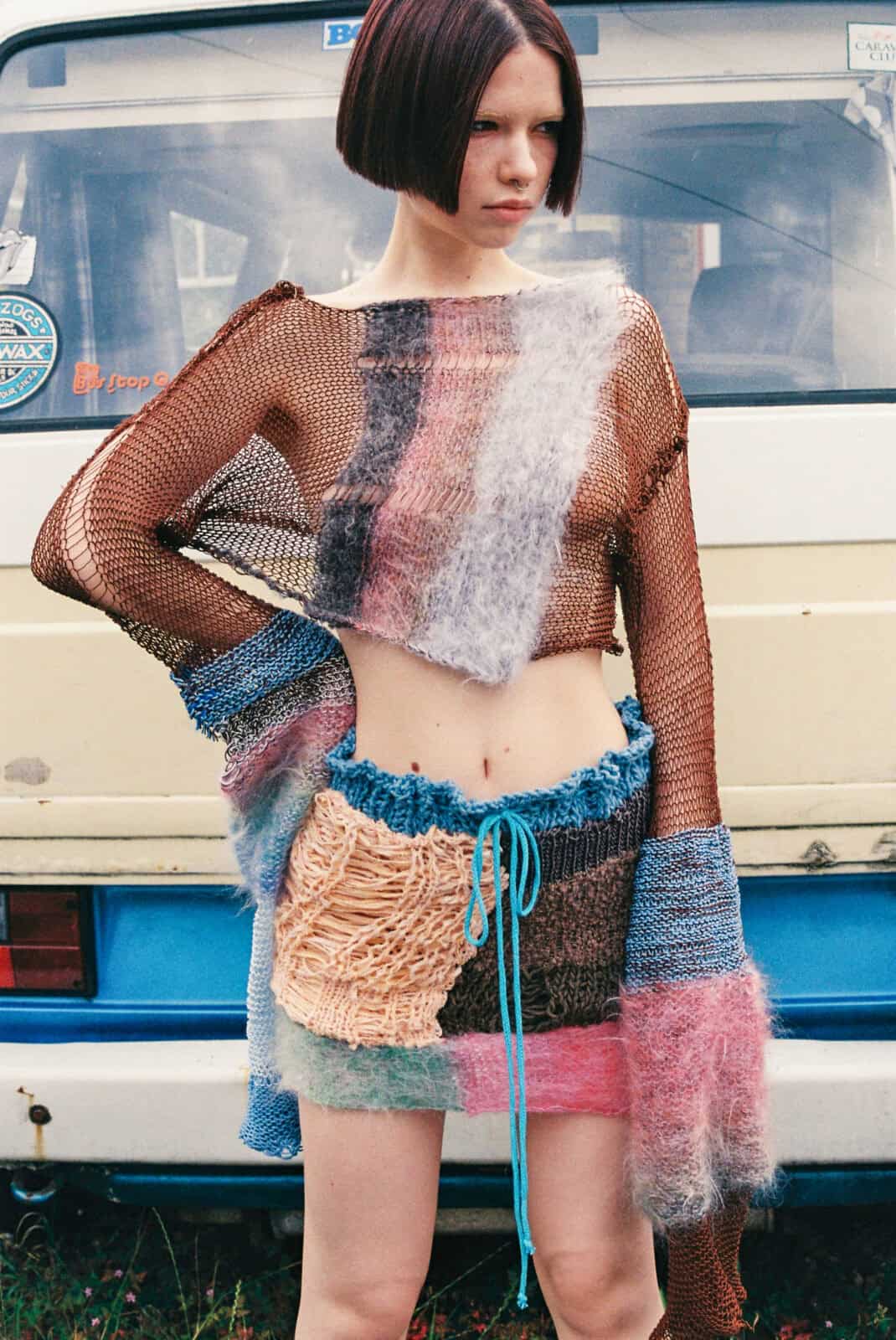
SB: A lot of my pieces are one-of-a-kind, and with those, the process is really intuitive and sporadic. I’ll get excited by a random colour combination or a new yarn and just start knitting a vest – which might then start looking better as a dress instead, so I’ll keep adding and building on it. I often abandon a project if it starts feeling boring; I’ll leave random knitted strips sitting in a basket for months, and then suddenly I can see how they piece together. I’ll play around and drape them on a mannequin until something clicks. When I’m making pieces for made-to-order, it’s a lot more considered – thinking about what’s actually commercially sell-worthy. But honestly, I find planning things out that way pretty boring compared to working spontaneously.
CM: What’s your favourite part of designing/making?
SB: The beginning and the end – everything in between is not relaxing! The start is exciting, full of hope for what it’s going to be. Then I’m racing to get through to the finished piece, my hands and arms aching. I don’t find knitting therapeutic the way other people seem to, I find it a mission to get through. But then, suddenly, it’s finished – I see it on a model and think, wow, I can’t believe I made that. That feeling is the best. My style has been largely shaped by the need for speed in my work; for example, using bigger needles makes it quicker to knit something and it also creates the big holes/punky effect in my work.
CM: Where do you look for inspiration?
SB: I actually try not to actively look for too much inspiration if I’m honest, I find I start comparing myself, doubting, or inadvertently getting influenced by someone else’s work. I want it to come through me and through individual decisions during the making process. What inspires me is seeing yarn colours together and then feeling like I have to combine them and balance them, for example. But of course, you get inadvertently inspired through the things you like, it’s inevitable.
CM: You made the amazing clothes Emily Ratajkowski’s character wears in Too Much. How did that come about? Was it strange seeing your designs taking on a new life on screen?
SB: One of the costume buyers, a wonderful stylist called Daisy Marlow, reached out to borrow some pieces for a fitting. Emily was playing a knitwear designer in the show, and they wanted pieces that would effectively read as things the character had made herself. They liked them so much that they ended up buying quite a few, which shaped most of her wardrobe in the end! It was really cool. We’d talked about doing commissions, but ultimately they just took pieces I’d already designed and we worked together on altering them for Emily. It’s funny, actually – I had Carlos from Fontaines D.C. in my studio the day before I got the email, picking up a balaclava he wanted after their stylist had used it for their press artwork. I asked him where he was headed afterwards, and he said he was acting in the show – then went straight to set wearing it. I’ve no idea whether that had any influence on the costume department reaching out, or whether I was already going to be contacted anyway, but it was a very strange coincidence! I went to set to watch her in it, which was an amazing experience.
CM: Is costume design something you’d like to do more of?
SB: Absolutely. If anyone is reading this, here I am!
CM: Your designs take tens of hours to make. What do you think about / listen to/ watch while you’re knitting?
SB: I watch so many movies. At one point I was watching one or two movies a day. I’m a particular fan of horror. You can’t watch anything with me as I’ve already seen it.
CM: As a small designer, how is it out there at the moment? What’s challenging you?
SB: It’s tough, I’ll be honest! There are so many talented designers out there, and I didn’t go to CSM or study fashion design, so I don’t have the academic side behind me or any of the potential advantages that coming from these establishments bring. Also, it’s been Summer, though I do make Summer wares!
CM: Unlike most knitwear designers, you don’t use machines to make your work. Has this been a difficult decision as your brand has grown? What do you think gets lost when we don’t work with our hands?
SB: I would like to start using a machine as my brand grows, in fact I will need to. The trouble is, hand knitting takes so long, you have to charge a premium for it to make it worthwhile selling. Machine work is still laborious though (and highly skilled, I must add!). I did a short course and it was difficult in its own way. I do think there is some charm to my work that is from hand knitting though, isn’t it lovely to know someone crafted every stitch of your piece with their hands?
CM: What do you enjoy about leading your knitting workshops? Do you think knitting can be a communal activity?
SB: I recently did one for a brand activation with LBTY (Liberty London’s fragrance line) at the Liberty store and I loved it! It is fairly stressful, though, teaching more than one or two people at a time. It’s really something you have to study up close to see. I also run a monthly knit and crochet cocktail club at a membership club called Maslow’s that’s open to the public. It’s so fun. We all sit around and stitch and bitch. I dress up and have a couple of palomas.
CM: Oscar Wilde called fashion ‘a form of ugliness so unbearable that we are compelled to change it every six months’. Is ‘ugliness’ something you think about when you’re designing?
SB: I suppose as I’ve gotten older I’ve gotten a little bit adverse to quintessentially “pretty” or very girly things, like twee knitwear. In that sense, I do stray from what is traditionally pretty as I find it dull. I like to challenge myself with weird and unusual colour combinations, for example.
CM: What types of materials do you use? Does this change seasonally?
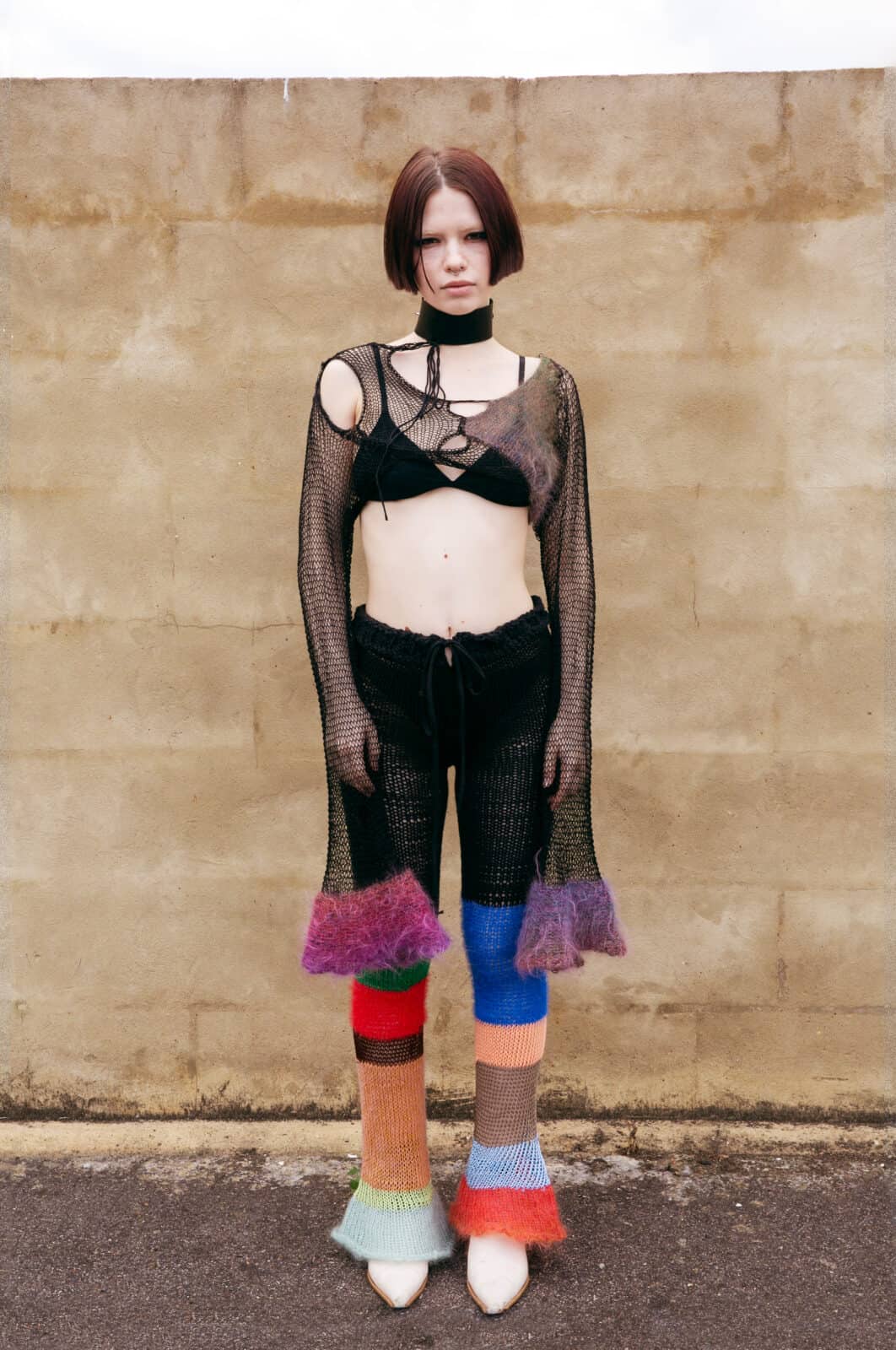
SB: I love anything that provides some texture. I love mohair which you can brush out in the Winter, and I love something called eyelash wool which looks a bit spiky.
CM: What would you most like to knit yet that you haven’t?
SB: Some wall art and menswear. Right now I have to think about selling, but when I have more free time for creativity, I will be making some fibre art to frame.
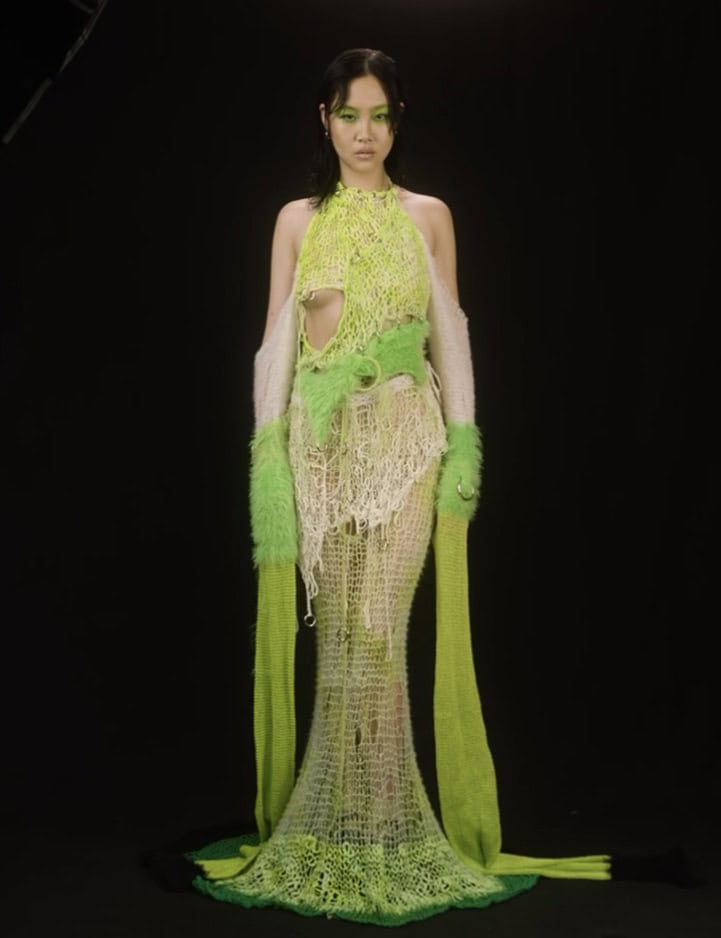
CM: Harry Styles’ jumper made it into the V&A. If you could put a piece in a museum (by you or someone else) what would it be?
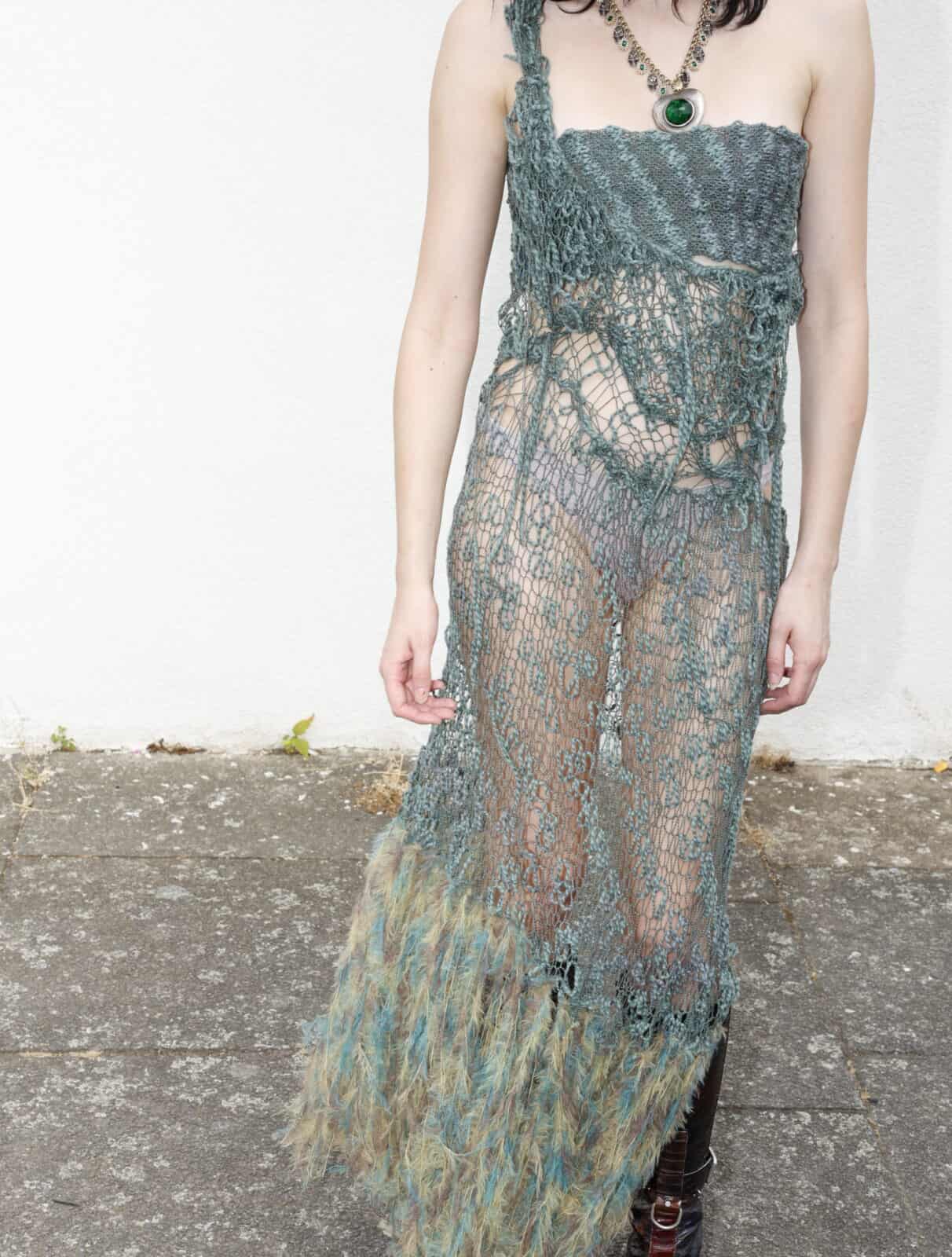
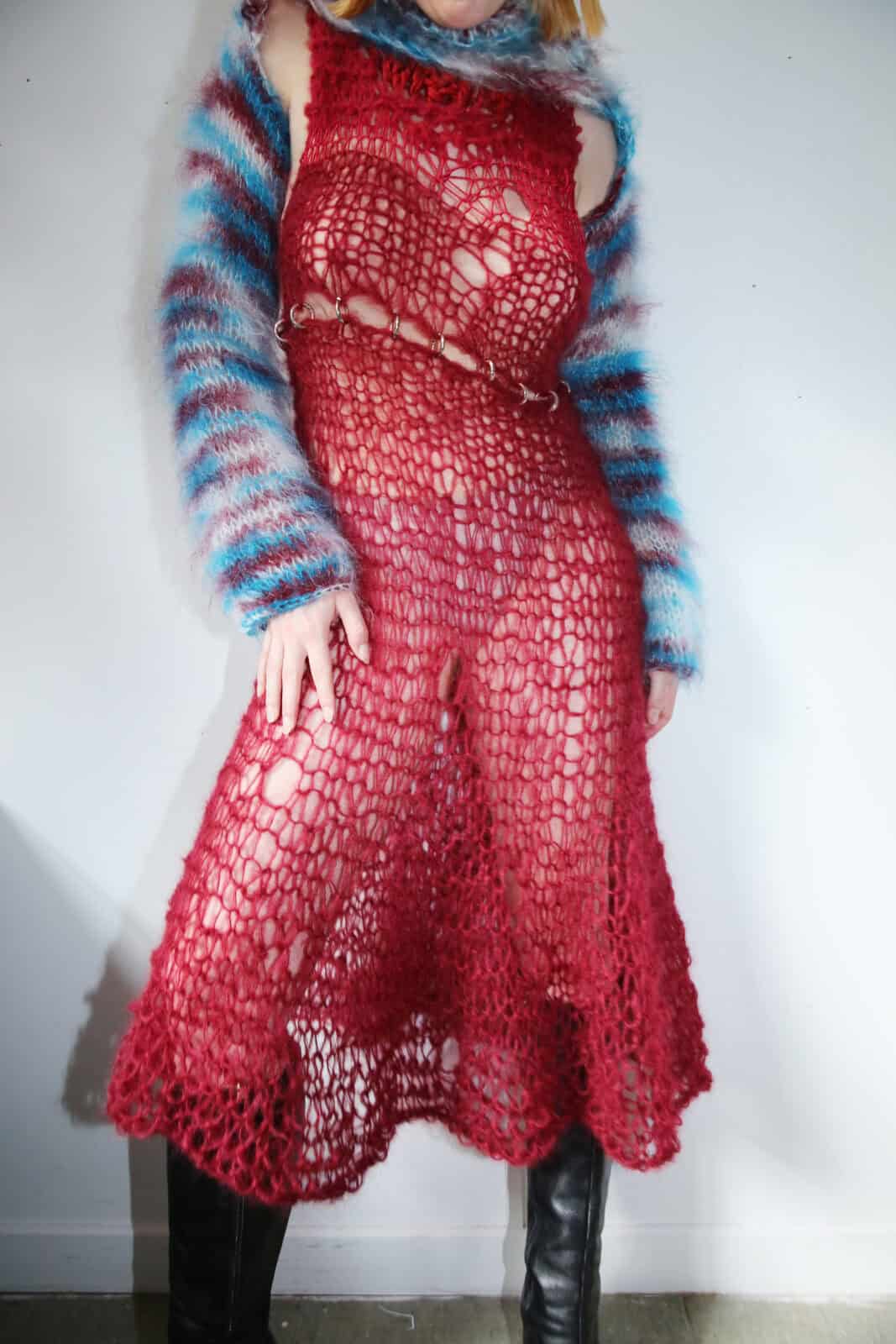
SB: (Photo below) It would be my own, this gown that took me about 80 or more hours to complete. It was for an exhibition for Bleach London; I handknitted, draped and painted it with their hair dye.
CM: Do you ever have dreams about knitting?
SB: Probably more nightmares, that I’ve missed a commission deadline.
CM: Final question – what’s it like working with your mum?
I love it – she’s wonderful, and helps me knit the balaclavas while I focus on the larger pieces! Sometimes she doesn’t trust my colour combinations, but I tell her to just trust me. She’s also started getting more adventurous herself, coming up with some of her own ideas too. I love her opinion, and I love her! I honestly wouldn’t be where I am with any of this if it weren’t for her teaching me, and having the patience to correct all my mistakes for those first 18 months. I think I would have given up otherwise! So thank you, Mum – still correcting the occasional mistake, if I’m honest…