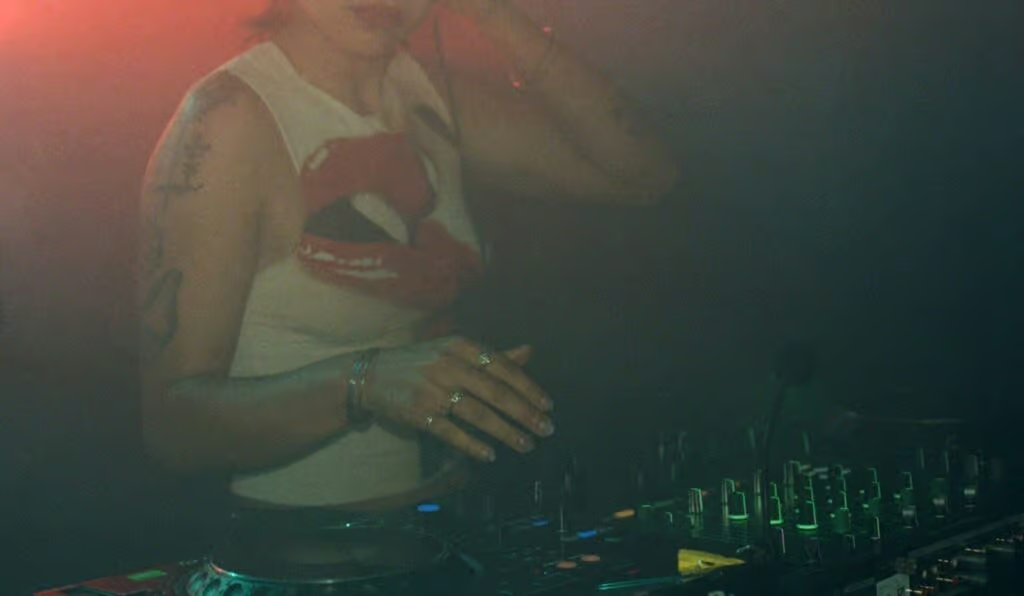
If the 1970s had rock gods and their groupies, and the 1990s brought about the rise of the boy band, then what is the 2020s answer to the musical sex symbol? My answer is simple: the DJ. These days, being behind the decks is simultaneously a coveted position and a presumed relationship death sentence. Even at a house party, it is an undeniable status symbol, akin to those before us on stage at a rock concert. Open Instagram and you’re hit with reels upon reels of recorded sets, generalised declarations about ultra-specific venues, and jaded text posts. Events are painstakingly categorised as “underground” or “reality escaping”, and “just wished him luck on his DJ set tonight. fml im so weak”, a post made with Instagram’s Create Mode by user evildelusionalhot, has over 64,000 likes. It increasingly feels like everyone has a story to tell.
The resurgence of a “party girl” era, which attempts to fulfil all that we promised ourselves about the Roaring Twenties 2.0, is, at its core, a resurgence of debauchery. The DJ has become a figurehead of this renaissance, providing both the soundtrack and the extracurricular activities. It is not quite clear exactly when the concept of the DJ became synonymous with promiscuity, but synonymous it has become.
For decades, the figure of the rock god was closely intertwined with that of the sex symbol. Emblematic of hedonistic primal desire, an association with one, however fleeting, was a universally recognised status enhancement. Then, in the 1990s, boy band-mania took over. This phenomenon was different, establishing a wider gap between artist and consumer, as images were scrubbed up and polished. Gone were the days of those notorious backstage liaisons – being a groupie was no longer a full-time job.
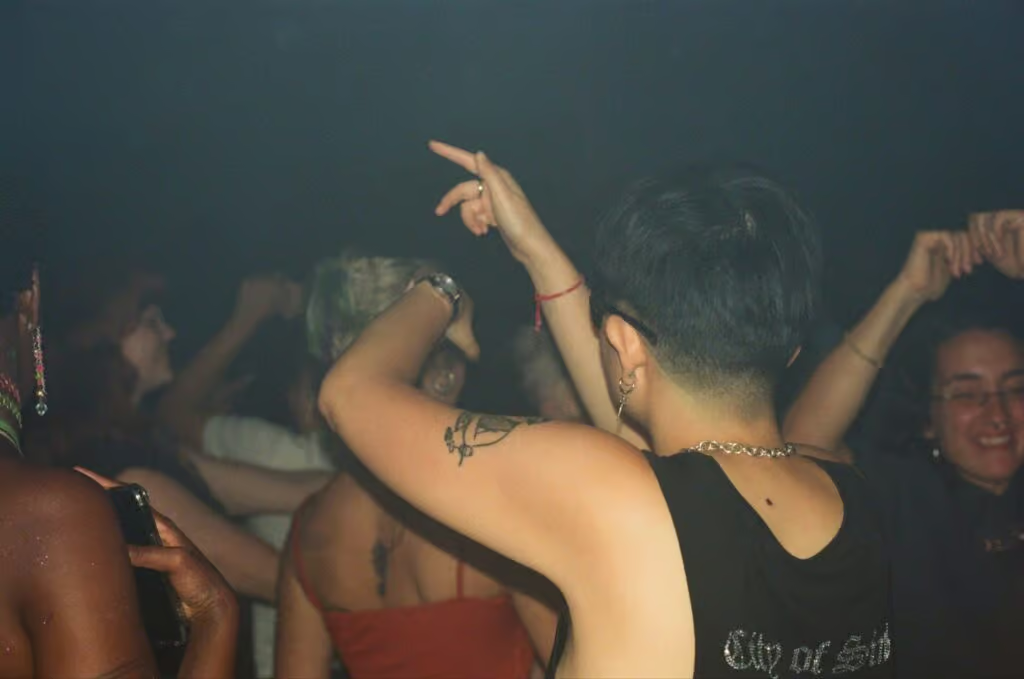
And now, the DJ. The DJ represents this aforementioned swing back towards debauchery, but this time with the disillusionment and cynicism that all but characterises the 2020s. Despite the static nature of performing electronic music, the DJ is hyper-aware of their presence, safe in the knowledge that any moment could be recorded and uploaded in seconds, that there could, potentially, be hundreds of cameras on them at any one time. It is this acclimatisation to immediacy and excess which further manifests in budding relationships, as modern-day love stories are littered with terms such as “love-bombing” and “situationship”. In a society that has been deemed metamodernist – the oscillation between modernist aspiration and postmodern cynicism – our simultaneous desire for connection and unwillingness to forfeit our freedom slots in perfectly.
Recently, I read Just Kids by Patti Smith, and found myself fascinated by the fluidity of relationships between artists, and the role of both music and drugs in facilitating this. Has LSD been replaced by MDMA, which has subsequently been superseded by everyone’s favourite recession indicator: Mcat? Of course, the role of drugs in these spaces cannot be overlooked. A 2001 study determined that MDMA increased both “desire and satisfaction” in more than 90 per cent of subjects. Though taking drugs in order to enjoy art, in any shape or form, should never be viewed as necessary, there is no denying that drugs, especially uppers, can feel as though they enhance certain aspects of certain music. Similarly, they can enhance certain elements of sexual activity. There’s a reason why sex, drugs and rock and roll pair so well. Sub out rock and roll for techno, and the DJ’s pedestal starts making a lot more sense.
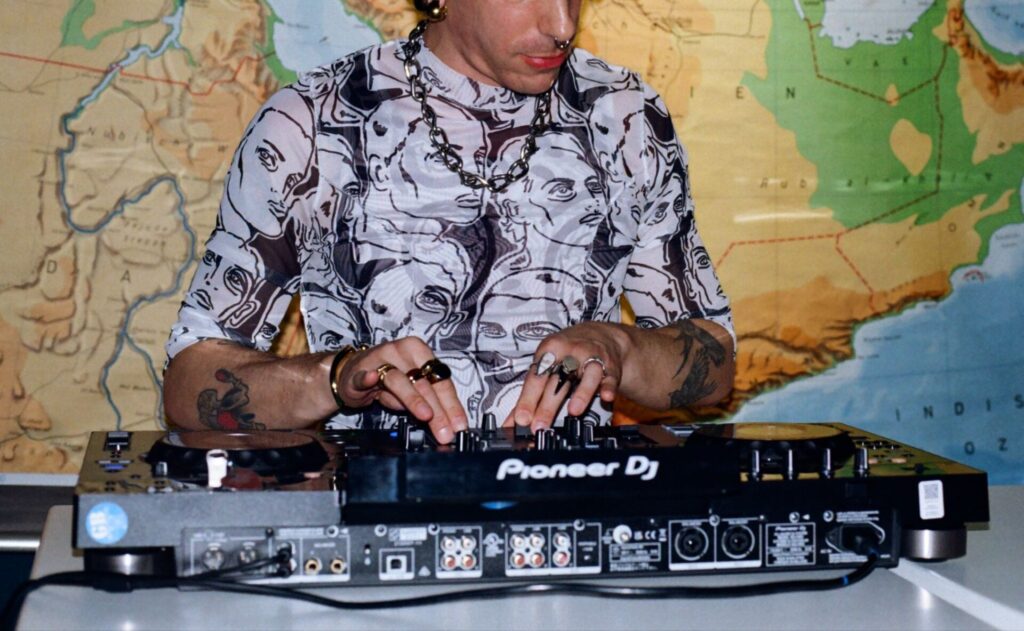
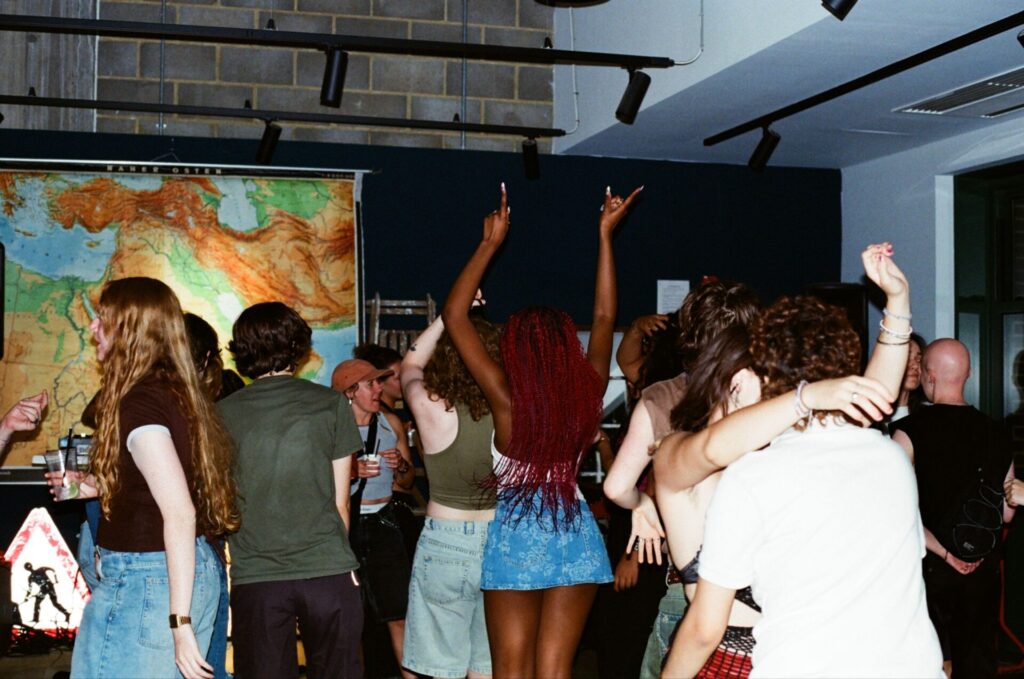
Throughout history, there have always been what we now deem “fuck boys”. Most often, these have been creative souls. If Lord Byron had lived today, he would be behind the decks at some warehouse in South-East London, prancing about with massive pupils and at least six beautiful women standing behind him. Bach had twenty children, and Diego Rivera was married five times. Perhaps the appeal is artists themselves and their creation of something tangible. The DJ is a solid reference point, a beacon of light amongst throngs of sweaty bodies and flailing limbs. Their iconography is universally recognisable. Decks have, in my opinion, eclipsed the “sl*tty silver hoop” as a tangible token of immorality, the equivalent of a male peacock fanning his plumage. It is widely acknowledged that the vast majority of DJs are male, with the elusive concept of the ‘girl-DJ’ evolving into its own sub-genre on social media and beyond. That being said, collectives such as London’s Jungyals and Gays are in the process of correcting this, foregrounding female and non-binary artists in their mission to provide “a safe space inclusive for women and the queer community to dance”.
Though these individuals exist, as they do in any scene, the fluidity of relationships in these communities is certainly not reprehensible. In fact, the “ethical non-monogamy” that many tout as the backbone of their romantic and sexual experiences appears, to me at least, as an extension of the appreciation that is held for one another’s craft. You may not be able to fuck the art, but there’s nothing stopping you from fucking the artist. If more of us identified as polyamorous, would we be happier? Accept humankind’s conditioning as monogamous beings as exactly that – conditioning? It seems as though any non-monogamous tendencies are yet another enhancement to the music at hand, a means of further immersion. An evocation of the “free love” movement that preceded it, this time attuned to the breakbeat of jungle and hypnotic rhythms of trance.
The other day, on something of a whim, I found myself in a record-shop-turned-performance-venue in the early hours, in New Cross. Despite its maximum capacity being one hundred, and there being around thirty or so bodies floating in and out, pupils the size of the spinning vinyls and jaws swinging almost rhythmically to the music, it soon became apparent that there were four of us there who… knew the same person.
“Another victim!” is how I was introduced to one: beautiful, blonde, and a talented DJ herself.
After three of us take a picture, a tactical Instagram story that has (to my great relief) never seen the light of day, my head was similarly left spinning. Some of us were angrier than others, but the sentiment was clear, and unified. It felt, in short, equal parts hilarious and aggravating, a sense of inevitably that we’d all individually opted to overlook. Perhaps the DJ is a self-fulfilling prophecy, or perhaps it is our own indulgence that affords them this unrelenting power. Either way, it’s definitely got something to do with those who work with their hands.