
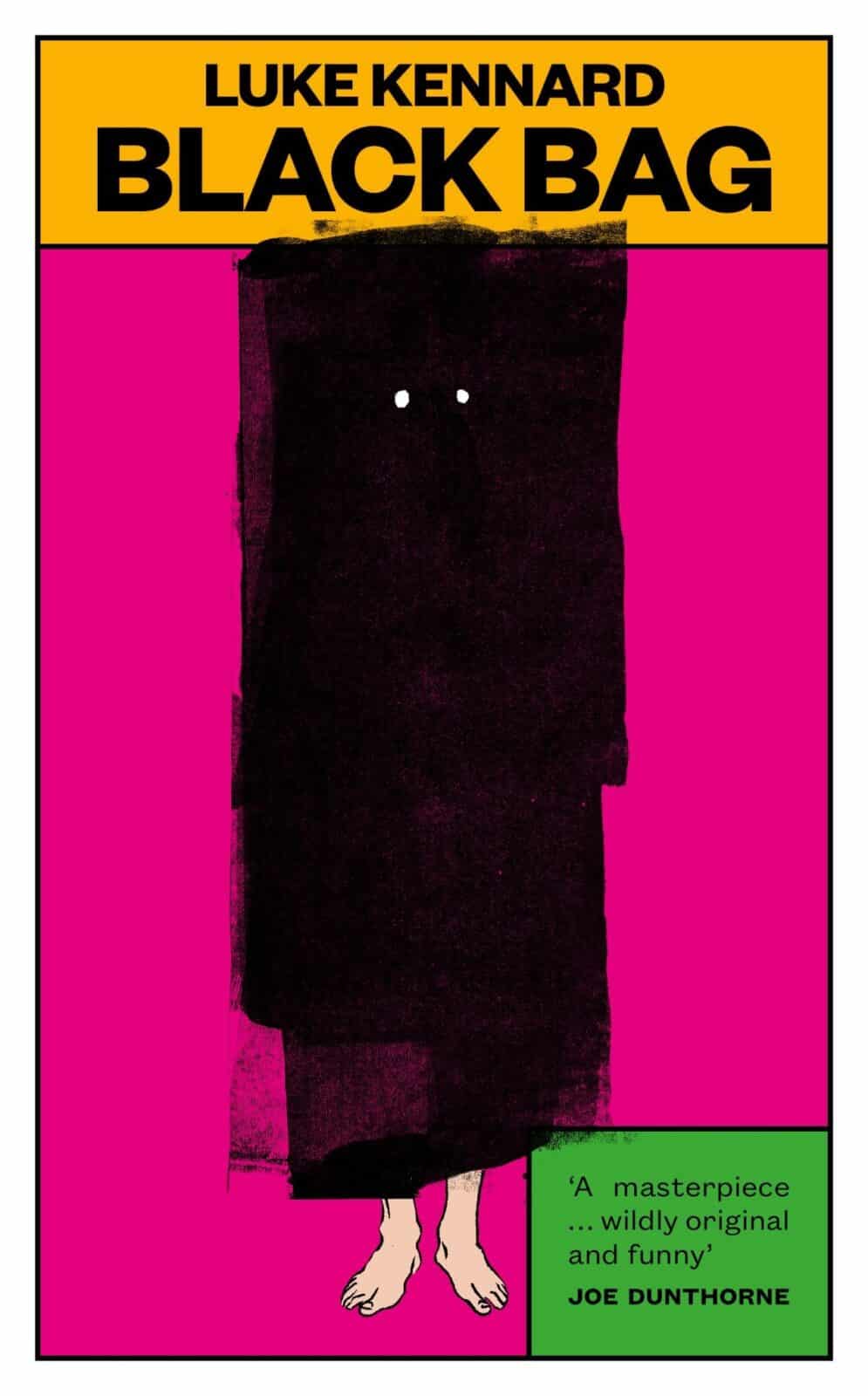
Thank God for this funny book. In a Booker Prize shortlist that includes tales of homophobic murder and suicidal ideation in the midst of the 2024 U.S. Presidential election, Luke Kennard’s Black Bag is a breath of fresh air.
A campus novel for our modern age, Black Bag follows a down-and-out actor as he takes up the greatest gig of his career: sitting at the back of a university lecture hall, silent and unmoving, zipped inside a black bag.
It’s a psychological experiment conducted by a man named Dr Blend, who wants to measure his students’ reactions to Black Bag throughout the autumn term. Our narrator takes to the experiment with gusto, declaring, “This is my big chance to do absolutely nothing, as thoroughly as possible”. A zany cast of characters soon joins the fray, including a childhood friend turned livestreamer and a post-humanist professor conducting her own research.
The novel is absurd, yet deeply earnest, and it looks deeply at masculinity, friendship, and the drive to make art in the 2020s. In our conversation with Kennard, we asked him his thoughts on the manosphere, what authors inspire him, and the importance of being “moved” by literature.
The Cold Magazine (CM): Your book has been discussed as a meditation on modern masculinity. So much of the loudest discourse around that topic feels very Andrew Tate-focused, yet that manosphere-adjacent philosophy doesn’t end up featuring much in the book. Why not? For you, what other aspects of modern masculinity may also be important and perhaps overlooked?
Luke Kennard (LK): When I was writing I suppose I felt that some things are so far beneath contempt we cheapen ourselves by even engaging with them. I wanted Claudio (the narrator’s childhood friend turned streamer) to be a basically sound guy. I wanted the narrator to be a deeply neurotic, oversensitive and slightly snobbish guy like me.
All people are difficult and complicated regardless of gender but what interests me about masculinity is that it’s an unconvincing mask for the truth. Generally speaking: Men are very sensitive, very emotional, and they deal with heartbreak and grief absolutely terribly. They find it difficult to adapt to change and they’re scared of conflict and of not being loved.
Again, generally speaking: Women are tougher and more pragmatic. And we’re all supposed to collude in the lie that it’s the other way around. I guess because men are more prone to extreme violence and rage? As if that’s the marker of an emotionally regulated human being? There are plenty of really great things about men, too, it’s just that we’ve got the core qualities completely mixed up.
CM: What importance do you place on the idea of “masculinity” (or even “femininity”) as part of a man’s identity in 2026? Or perhaps you don’t find these useful terms?
LK: I don’t think we’re getting beyond those ideas any time soon, but at least there’s a language to talk about it, which there wasn’t when I was growing up.
I think I’m quite feminine in my affect sometimes, but I’m also quite tall, and stocky, and in my mid-40s, so I’m less at risk of getting shit for it than I was as a willowy teenager growing up in a small town.
I think I absolutely would have described myself as non-binary if that had been a thing in the 90s. I don’t know if I feel like it’s too late for me now or something – I don’t know how I feel! And I’m okay with that. Maybe that’s part of what I was exploring in Black Bag: I’m okay with that.
CM: How far would you say you identify with Black Bag? What about his personality as a narrator and character did you enjoy writing?
LK: My partner insisted I include a brief physical description of the narrator, and that I make him look different to me. “Because otherwise it’s just you”.
I loved adopting this kind of irritable, opinionated, unilaterally disappointed voice – I suppose I kept turning the dial up on that. How irritating can I make this but he’s still, on some level, charming or funny or appealing in his self-sabotage? It’s what I’ve always done in poetry: Be yourself but worse.
CM: Do you find the idea of being Black Bag attractive? Why or why not?
LK: I’m okay with that, but also it genuinely appeals to me to disappear into a large, oblong leather black bag and never emerge.
CM: I found it such an enjoyable novel to read, and full of fun. What novelists or book narrators inspired your style in Black Bag?
LK: That makes me happy – thank you! This is a little off-beat, but some of the influence for the voice came from August Strindberg’s journals (one of which got published as a kind of novel, called Hell, but it’s also literally his diary).
His writing is incredibly funny – petty, vengeful, completely self-absorbed – although for Strindberg it was deadly serious. That’s quite key, I think; sometimes my narrator is trying to be amusing, most of the time we’re laughing at him and the things that happen to him and his impetuous response; there’s little funnier (and sadder) than trying to keep your dignity in a world that’s decided you’re ridiculous.
Iris Murdoch’s debut Under the Net has some incredibly well-timed extended jokes (like accidentally kidnapping a movie star dog), and that was definitely an influence. I think also American geniuses like Donald Antrim – his work is profoundly funny and strange. The long opening paragraph of The Hundred Brothers is one of my favourite things ever written.
CM: For the most part, this novel is lively, silly, and philosophical. It’s not awfully emotional. How important do you feel it is that a novel “moves” its reader?
LK: This is a good question because I think I’m so squeamish about sentimentality in art (not in life, I’m sentimental about everything in life) that I have to be reminded to include any emotion at all.
I’ll lean a little further into fear in my next project, I think. Sometimes I feel like we confuse being moved, or our reaction to a prolonged and somewhat sadistic portrayal of suffering, with a profound literary experience when what we’ve actually done is the mental equivalent of stubbing our toes.
On the whole I’d rather be moved quite unexpectedly in a work that doesn’t court that reaction. But I also love those lines from Berryman’s “Dream Song 53”: “It takes me so long to read the paper’, said to me one day a novelist hot as a firecracker, because I have to identify myself with everyone in it, including the corpses, pal”. That’s just a basic duty as a writer.
CM: Animals seem to interest you. We have the scathing dog Elliot here, and in your poetry collection Notes on the Sonnets, you include a talking horse. What about these creatures do you find so compelling?
LK: Some people do voices for their pets, some just love them and talk to them; I’m in the former camp and I tend to project a fairly judgmental personality onto every animal I meet.
Partly because it redresses the power imbalance. [My partner] Holly’s dog continually calls us “dumb apes” and I genuinely believe that’s just giving voice to her thoughts. As the oldest of four I like to think I entertained my siblings with my near-constant stuffed animal voices, but in retrospect I think I was subjecting them to a hellish total theatre.
Maybe there’s something of that child-like sense of improvisation and imagination; I value that and I think it really needs defending.
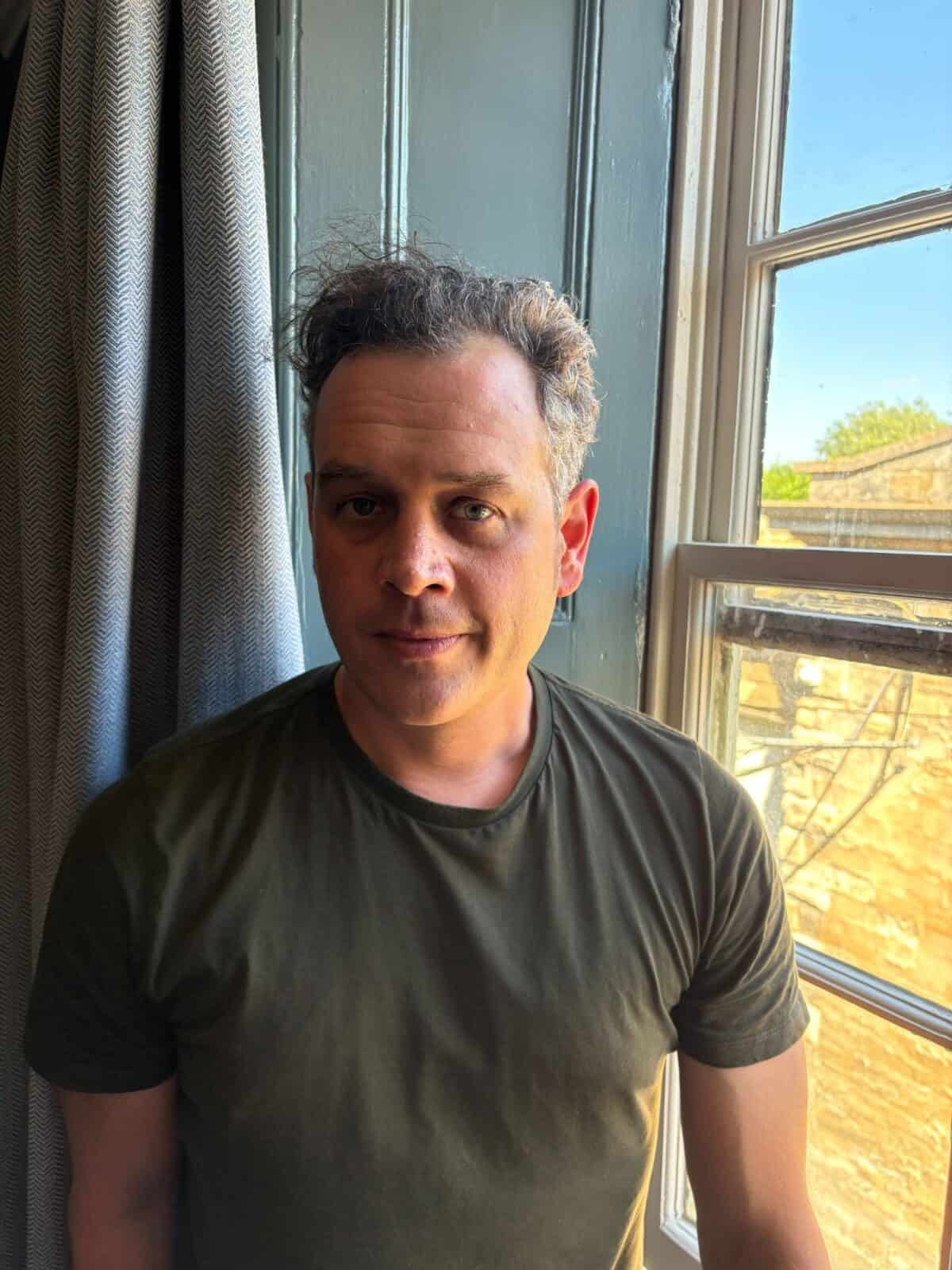
Photo by Holly Pester
CM: What’s your favourite moment in Black Bag?
LK: I like it when Elliot tells the narrator that his parents like to read “books of note”. And I’m proud of the interrupted patisserie hand-job. Talking to a friend once we agreed that there should be a sub-genre called Eratica – erotica but a bit off.
CM: Which character(s) did you most enjoy writing?
LK: I liked writing Justine, enjoyed the slightly sub-dom situation with the narrator… Initially Dr Blend’s lectures were super long and I enjoyed writing them a lot, as a kind of parody of Jordan Peterson. Eventually he turned into quite a different character, a different kind of sad professor.
CM: What book do you think everyone should read?
LK: To keep this thematic, I’m going to pick a couple of books that have some profound observations on masculinity. This year: Dad Had a Bad Day by Ashton Politanoff. Next year: Dishonest Days by Richard House.
CM: What are your own reading habits like? Do you often have poetry and prose on the go? What have you been reading lately?
LK: I’ve been getting sent a lot of proofs recently, which I love. I just finished Jenny Mustard’s Karro (wonderfully atmospheric, subtly based on Anna Karenina); Francesca Reece’s Sleaze (ecstatically great literary thriller); Ellena Savage’s The Ruiners (enviably brilliant character writing centred around a Greek island).
I’ve preordered A. K. Blakemore’s Doom Painting, which I’m looking forward to. I always have one poetry book on the go (at the moment Graham Foust’s A Mouth in California) and one classic I’ve neglected to read (at the moment The Pickwick Papers).
I read a lot, but my day job means I need to mark around 750,000 words of assignments a year. I only recently discovered how important reading glasses are if I want to do this beyond 50.
CM: What movies and TV have you been watching lately?
LK: I loved Sex and Death at Camp Misama (the “Long December” scene made me cry. That moment where the grand guignol pauses briefly and you can see Little Death’s face through the aperture and they look so, so tired.)
I started re-watching Battlestar Galactica and then it got taken off the streaming service without warning. There’s a great, deeply weird anime called Bee and Puppycat I’ve been watching with my sons. Love is Blind because I really like hearing how people perform or describe themselves and their emotions (I’m being vulnerable, I’m on a journey). Looking forward to the next Slow Horses.
Black Bag by Luke Kennard was published by John Murray on 12 March 2026. The 2026 Booker Prize winner will be announced on 9 November 2026.


