A populist president with a background in entertainment and a blue collar base; a society gripped by rose-tinted nostalgia for earlier, simpler times; flaring culture wars; a resurgent religious right and a landscape in Hollywood filled with blockbuster spectacle. Is this a description of America in 2026, or 40 years ago, when David Lynch’s Blue Velvet was first released?
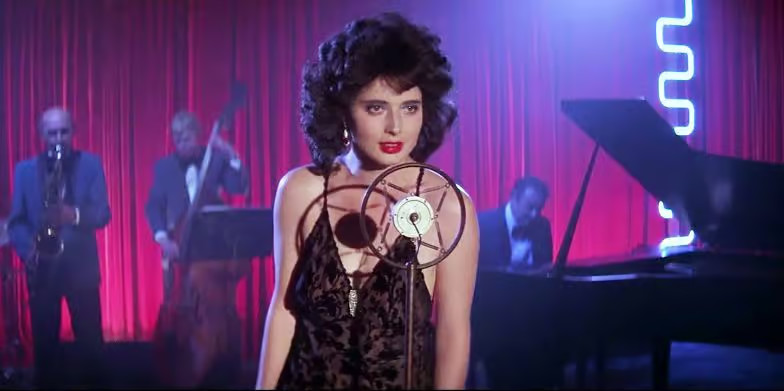
Blue Velvet follows Jeffrey Beaumont (Kyle MacLachlan), a good-natured college student whose discovery of a severed human ear in his small hometown sets off an investigation that takes him into the heart of America’s criminal underbelly, as well the murky world of his own subconscious. With the help of the local police detective’s daughter, Sandy (Laura Dern), Jeffery uncovers the town’s violent and perverse criminal underworld, a world run by Frank Booth (Dennis Hopper), whose abusive relationship with mysterious nightclub singer Dorothy Vallans (Isabella Rossellini) forces Jeffrey to confront his own capacity for violence and exploitation.
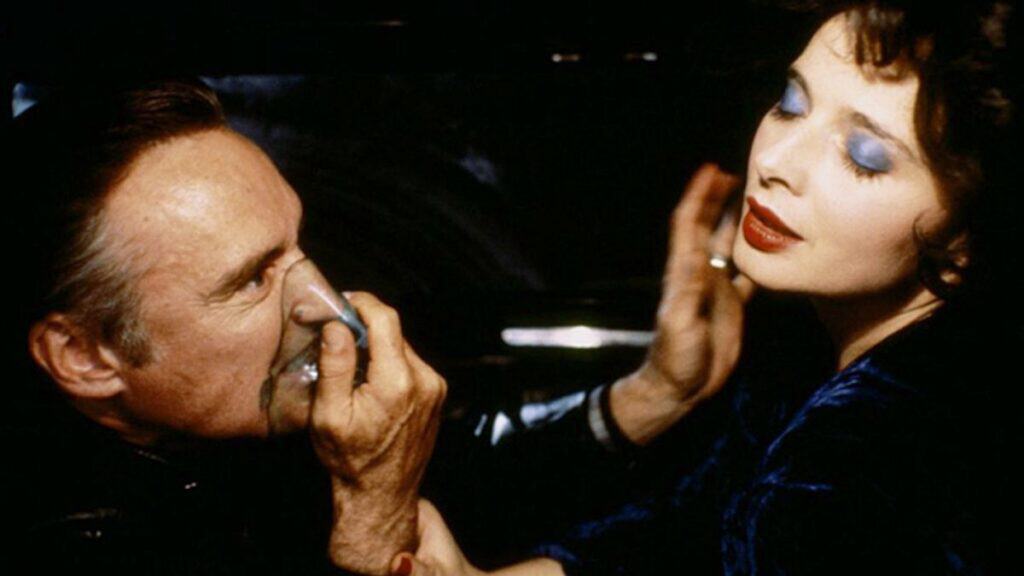
Hollywood filmmaking is intrinsically wrapped up in the wider story of the US, and the context in which Blue Velvet was released is no exception. While in the 1950s films widely reflected the decade’s socially conservative attitudes, and in the 60s/70s (the era of Vietnam and Watergate) radical and experimental films were being produced and finding larger audiences, by the 1980s the money men had arrived. A reactionary, box-office-driven Hollywood thus began to take shape; it was the era of the studio blockbuster. Enter Blue Velvet – a strange, personal film that blends times and genres, and brazenly subverts the dominant cultural attitudes and filmmaking styles of the time.
Off screen, Ronald Reagan was calling for a return to traditional American values, drawing heavily on the 1950s nostalgia that permeated American culture. His 1980 campaign slogan painted a wistful yet optimistic picture: “Let’s Make America Great Again”. Donald Trump was taking notes.
Blue Velvet both evokes and takes aim at that nostalgia. The ghost of the 1950s is everywhere in Blue Velvet: the depiction of small town American life at the beginning of the film – red roses, white picket fence and blue sky; the oversaturated, Douglas Sirk-like imagery; the noir-esque plot; the inclusion of music from the era (not least Roy Orbison’s “In Dreams”). But within this picket-fence pastiche are hints at the more complicated reality: in Sandy’s room hangs a picture of Montgomery Clift, a film star who had to hide his homosexuality and died tragically young, an emblem of the conformist contradictions of 1950s America. Additionally, following Jeffrey’s father’s stroke, the void where his family should be is filled by a kind of proxy, perverted nuclear family with Dorothy as mother and Frank as father.
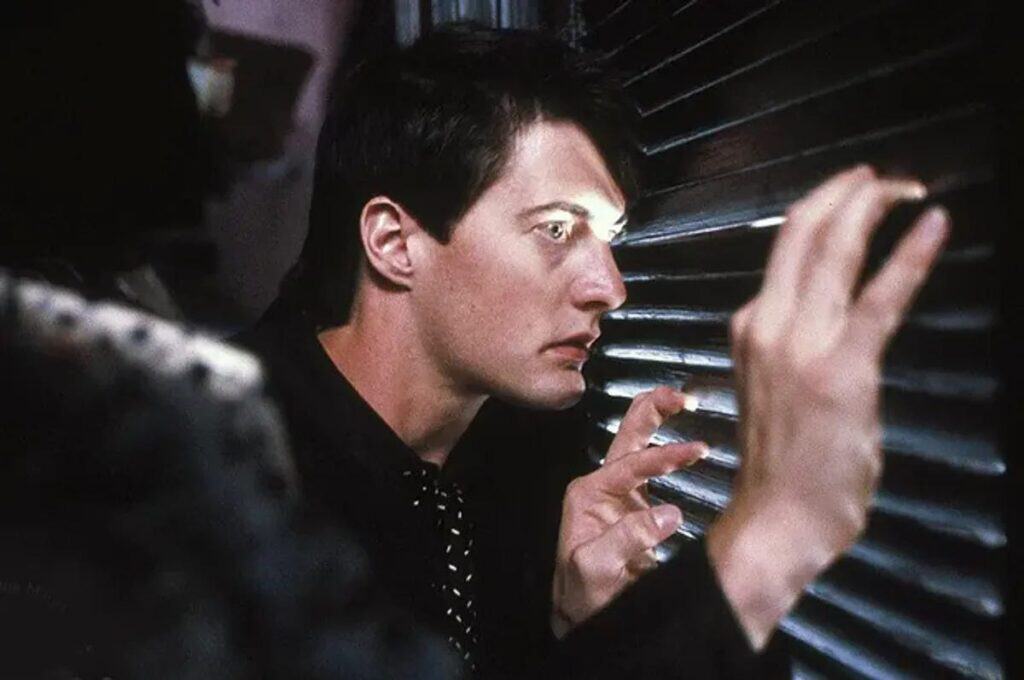
In drawing parallels between past and present, Lynch suggests that what was illusory before is illusory now. He punctures the bubble wrapped around American suburban life and dispels the myths surrounding the country’s glorified past. And forty years on, as Trump advocates for a return to a similar idyllic vision of conservative suburban life (itself a blend of 1950s suburbia and Regan-era conservatism), Lynch’s critique of American self-mythologisation remains frustratingly relevant.
Perhaps the film’s enduring relevance can also be attributed to cinema audiences craving something deeper than the endless sequels and reboots, the buff desexualised superheroes and artificial effects that define the Hollywood blockbuster today. At a time when the contradictions and hypocrisies of American political life are becoming increasingly apparent, when the fabric that holds its self-aggrandising myths seems to be tearing at the seams, Blue Velvet shows us that reality is far more disturbing, far more unreal than the world we’d like to live in. Like Jeffrey in the closet, we watch on, appalled and somehow compelled, unable to avert our gaze.