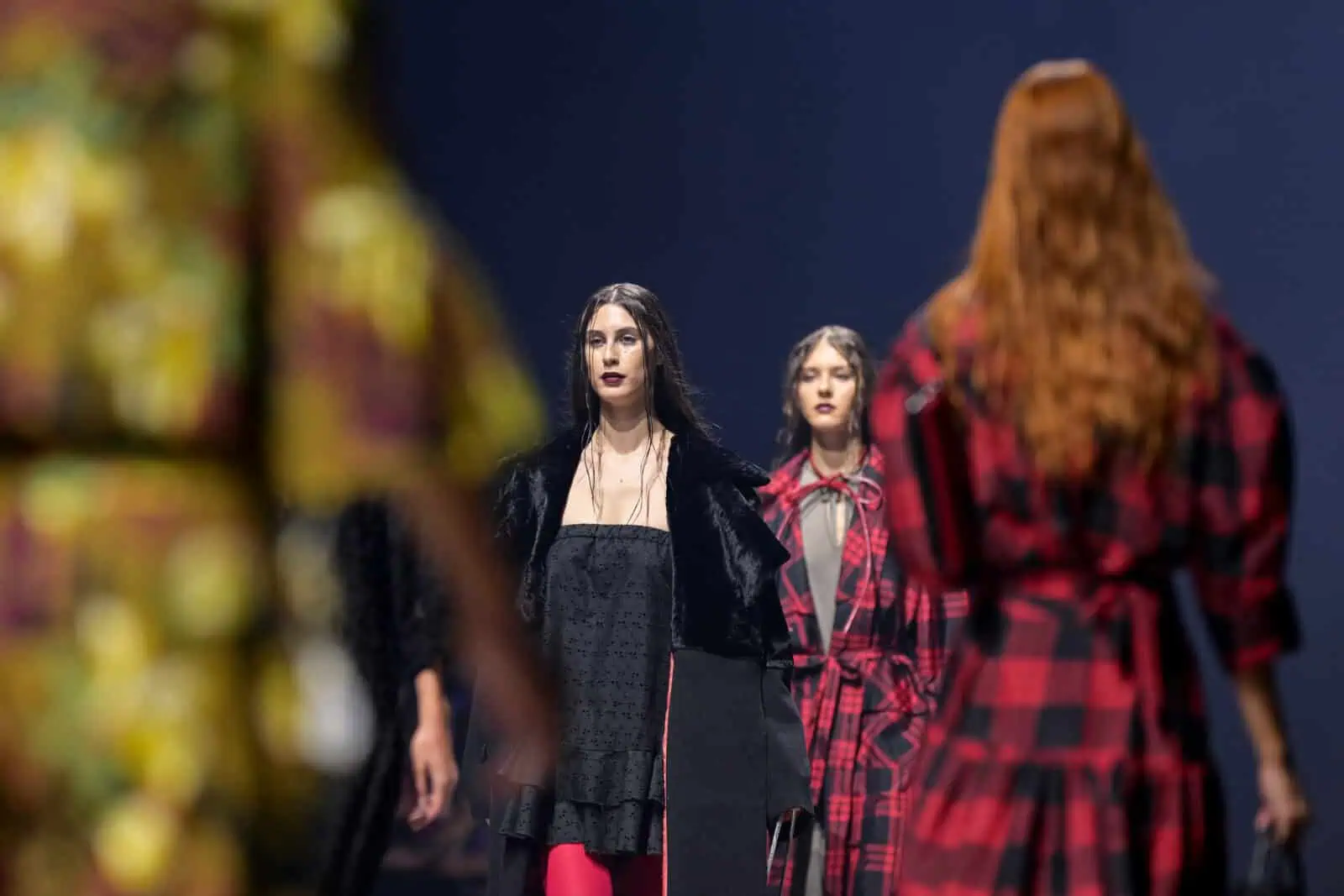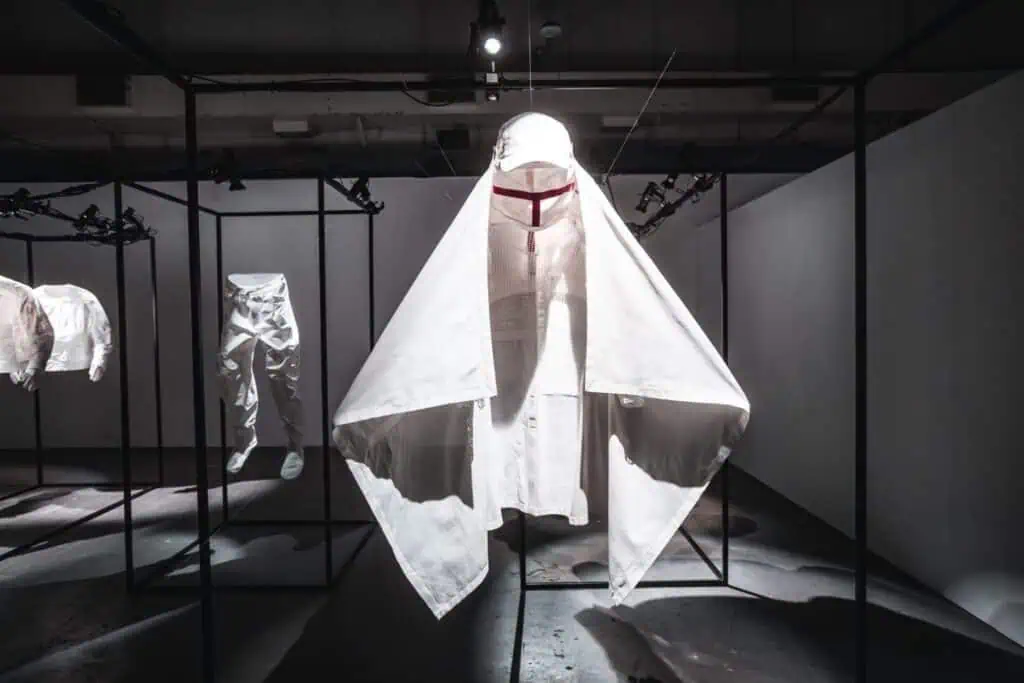
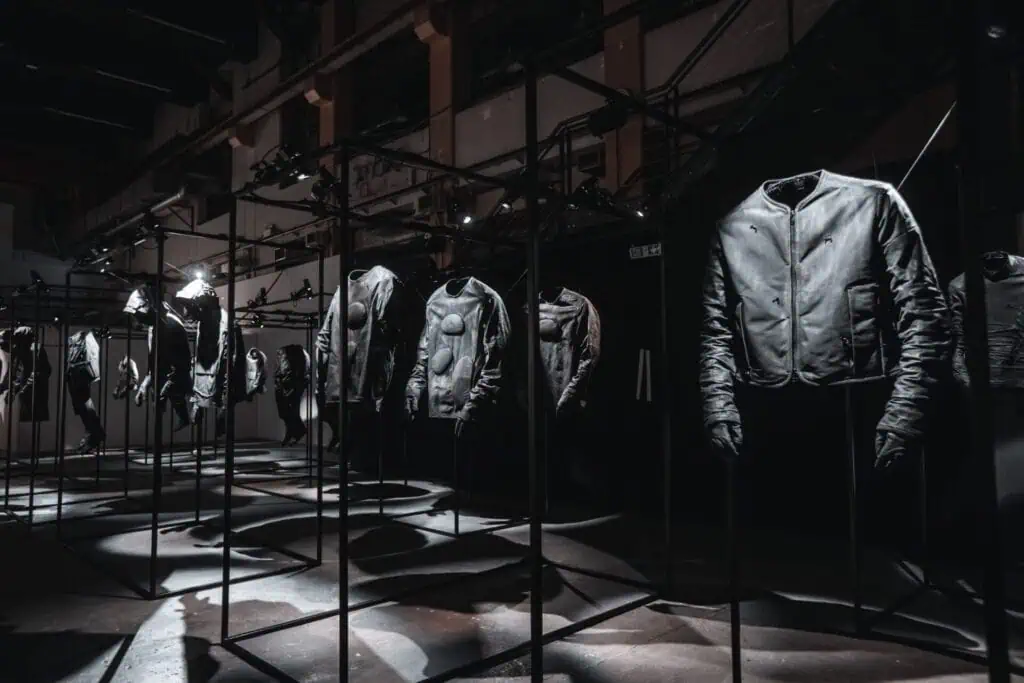
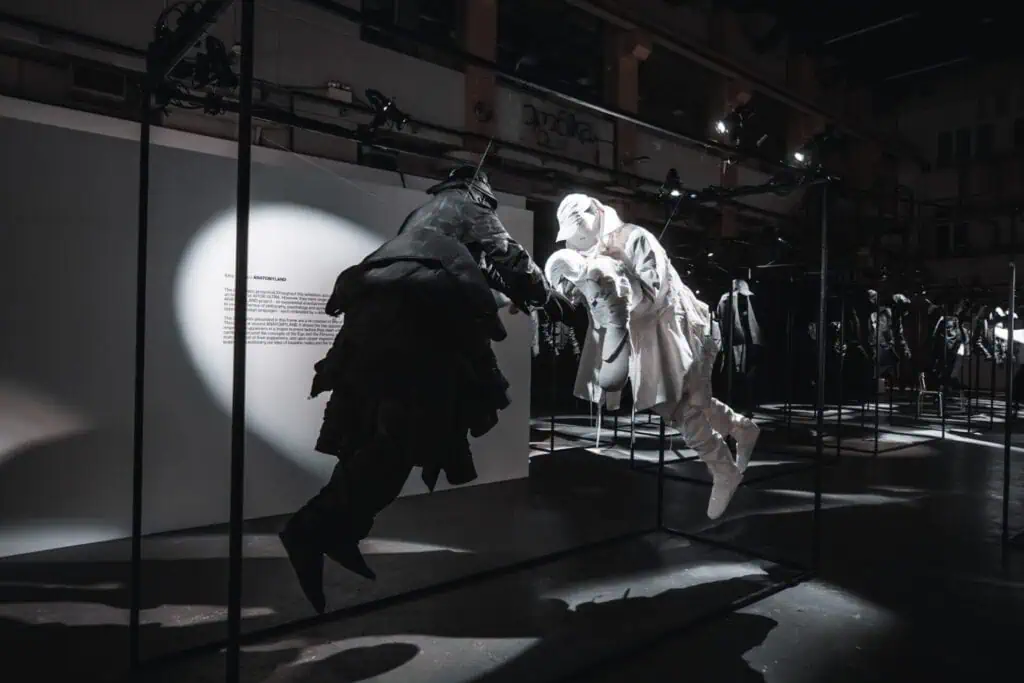
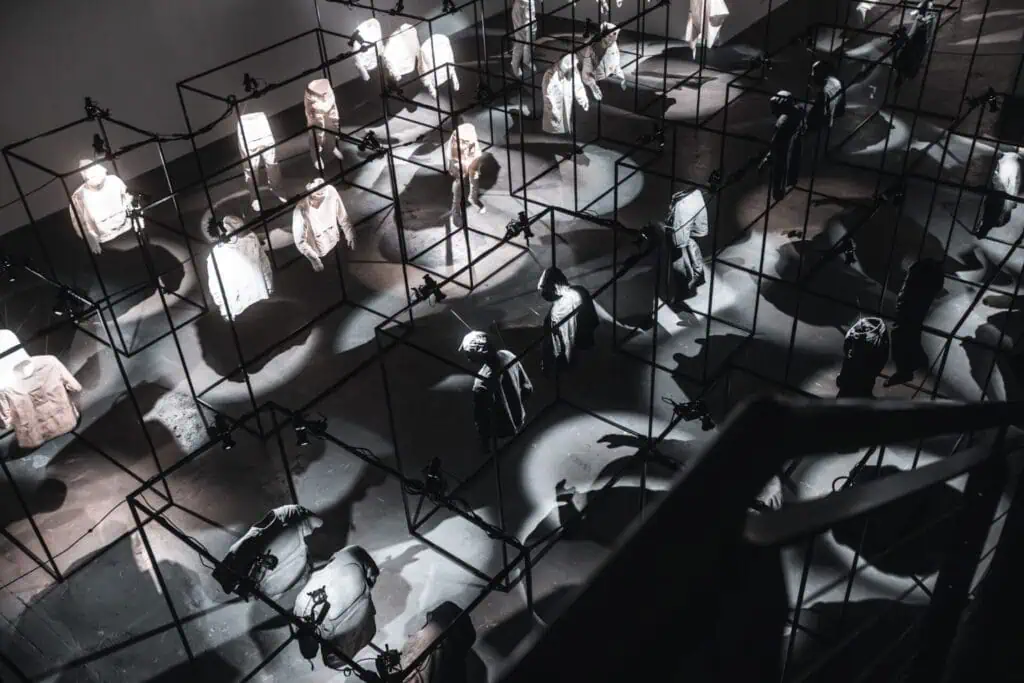
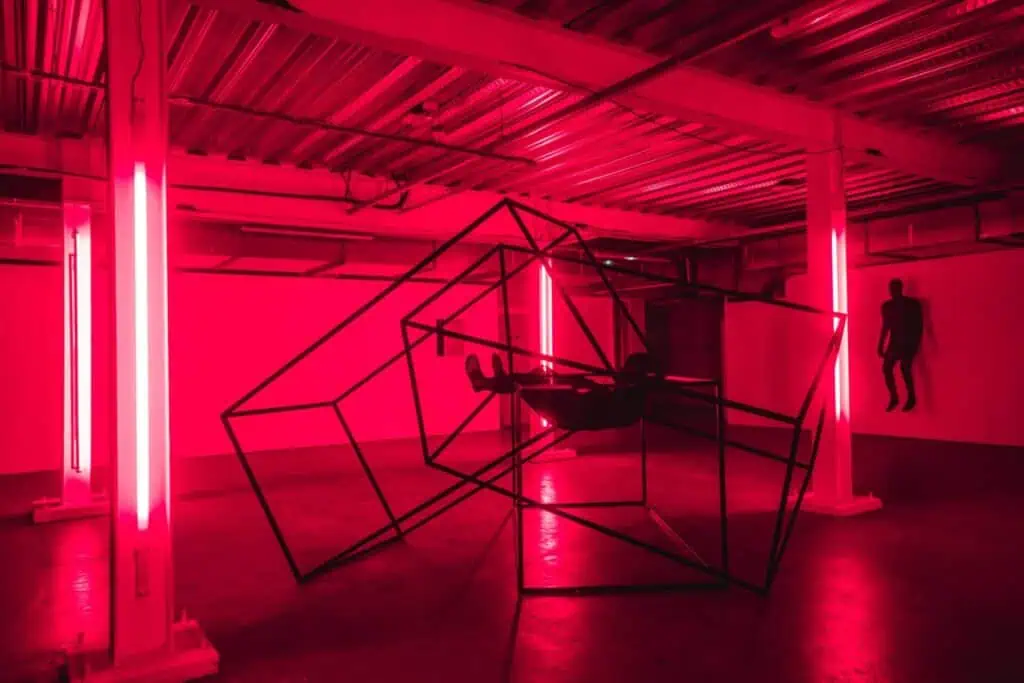
Beneath the streets of Marylebone in a former construction hall sit over 100 prototypes of garments and sculptures eerily suspended in mid-air. The new exhibition by multidisciplinary artist and designer Aitor Throup, titled ULTRA VEIL, is an amalgamation of over 20 years of his creative practice distilled into one body of work. The designer graduated with a master’s degree from the Royal College of Art in 2006 with his collection Football Hooligans Become Hindu Gods and soon became a cult favourite, collaborating with Umbro on England’s kits for the 2010 World Cup.
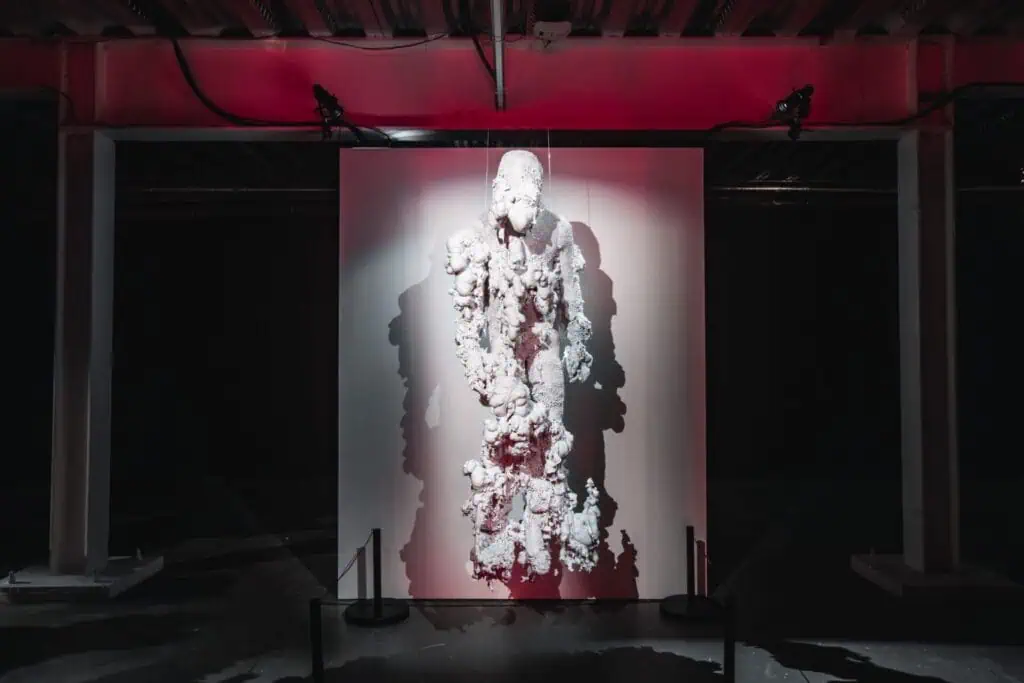
Presented by the Westminster Menswear Archive and supported by Fred Perry, ULTRA VEIL draws on Throup’s lived experiences of alienation and racism to explore the divided sense of ‘British’ identity. Utilitarian garments are stripped-back by washes of monochrome so remnants of the St George’s flag dart across the seams. Amoeba-like pockets form swollen lumps across the back of track jackets. Rogue objects on pedestals resemble human skulls oozing foam. Deliberately unfinished and evolving, the exhibition at Ambika P3 explores Throup’s philosophy behind each iteration.
COLD speaks to Aitor Throup to discuss his latest work.
The Cold Magazine (CM): Your work often portrays conflicting identities. For example, your fascination with British football terrace culture also serves as a critique of the far-right ideas that can be associated with it. How do you feel your experience of racism in the UK and dual heritage informed your previous collections? Has this evolved over time?
Aitor Throup (AT): I moved to England when I was almost 12 years old, and felt a great sense of deep-rooted alienation. For the first time in my life I felt judged, and at times rejected, because of my ethnicity. The football terraces provided a powerful paradox. On one hand the more expressive side of the English football fan psyche embodied the nationalist identity but at the same time the sub-culture created an aspirational sense of belonging for me.
I later came to learn that different areas of England followed unique variations of this unspoken dress code. The jackets in particular (mainly Stone Island and C.P. Company) were fascinating: metallic and reflective cloths, hoods with goggles, complex design features that made garments look like they ‘did’ something… Everything appeared to be utilitarian, but in a cartoonish, exaggerated way. It was the closest thing I had ever experienced to the world that I inhabited in my head coming alive. So these people represented a sort of truth for me – it allowed me to explore a space where my comic books, cartoons, toys and my own drawings could one day co-habit the outside world.
This of course planted the seed for me to eventually study fashion and as soon as my studies finished my long process of creating experimental projects began. I was subconsciously driven and inspired by the fact that I had infiltrated the identity that had originally been a source of fear for me. By going through the fear, I was able to find the beauty at the source, and dissolve any negative elements by re-appropriating it.
CM: The accompanying text in the exhibition mentions that your own mental health struggles drew you to exploring the brain and the idea of hemispheric lateralisation through your work. Elements found in ancient Chinese philosophy, like Yin and Yang, are mentioned too. How do these ideas manifest in your work? Is a piece ever representative of one ‘energy’ or is it a mix?
AT: During the first ten years of my work, I realised that all my projects were in some way about overcoming racism and oppression through transmutating its power. In the process of trying to define what the premise of my work is, I became obsessively analytical of my own practice, which resulted in publishing my ‘New Object Research’ manifesto in 2013. Even though this provided the foundations of a conceptual framework to my work, it felt too rigid and lacked the freedom of expression that I also seemed to hold. In this sense, I became increasingly aware of the influence of my analytical brain, which I found debilitating in my search for creative expression.
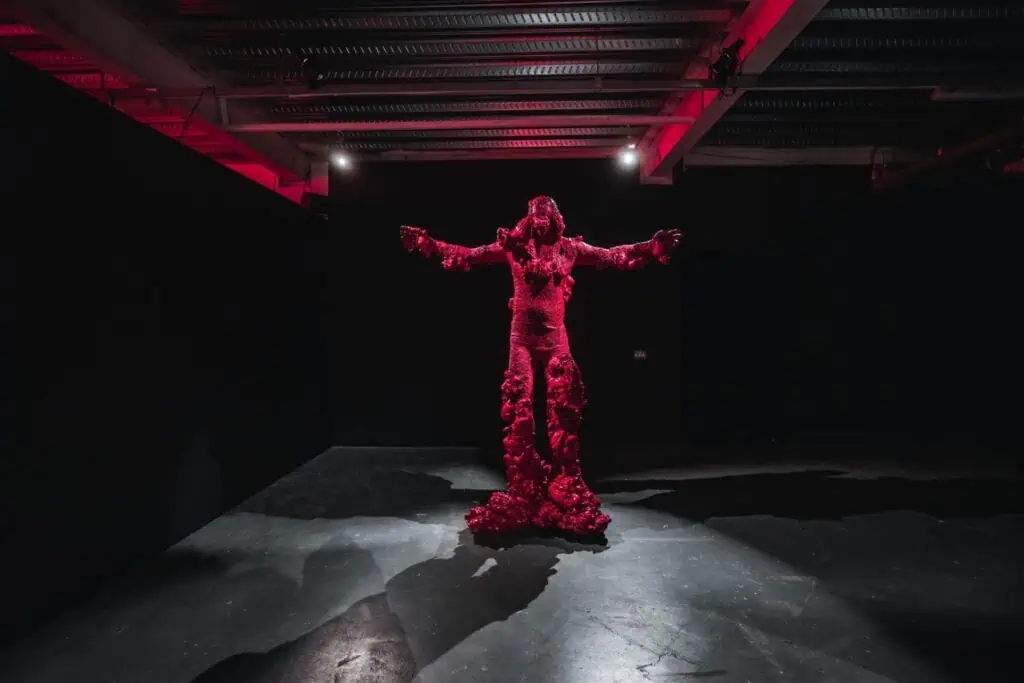
Motivated to understand this limitation, I studied philosophy, psychology and neurology, eventually landing in the field of Hemispheric Lateralisation and in particular became inspired by the work of Dr Iain McGilchrist. I began to draw parallels between the oppressive nature of the brain’s left hemisphere and that of systemically oppressive ideologies, including white supremacy and racism as a whole. I’m really interested in how we have created a Western society with norms that are essentially the collective creation of the left hemisphere. My thesis incorporates paradox into the structured works created by the left brain by using them as a canvas for the right brain to express itself in a form of vandalism. Precisely engineered garments are hand painted with a glittery rubber compound, compromising their controlled design language. Figurative sculptures cast from the human body with a thermo active grid material are injected with expanding polyurethane foam to create a new type of form. Archival drawings are mashed together into hybrid collages that express an uncontrolled stream of consciousness.
CM: A lot of your work seems to center around how to make inanimate objects tangible and more meaningful. Is this part of the reason why your exhibition travelled across multiple mediums? Do you feel wearable garments break down a ‘barrier’ between the viewer and object?
AT: I think that my work travels multiple mediums because I allow the work to dictate its own needs. I feel that ultimately the ideas want to be embodied in something that can hold, as if they’re alive, irrespective of the medium. When we interact with work that has been created we can instinctively sense a sort of life force within them. I think that’s when we refer to a work as being ‘inspired’. I love the idea that the etymology of ‘inspired’ is essentially ‘in-spirit’ so the creations that inspire us transport us back to our spirit. When we connect with something like that in our lives, it allows us to be reminded of our potential and in a way to project ourselves onto it. I think that is when clothing has the potential to do this more than any other medium as it’s literally a figurative reflection of our own bodies. My work aims to exaggerate that foundational aspect of clothing by crafting an intricate and layered product anatomy into each piece. The goal is that each piece has its own identity and character before the body even touches it.
CM: How were materials sourced and chosen for the prototypes?
AT: I started using lingerie mesh to create garments in 2012, for my ‘New Object Research’ collection and in 2017 collaborated with the amazing choreographer Wayne McGregor for his ‘Autobiography’ show, using this fabric as a symbolic interpretation of identity. It was the ultimate material to express the complex layered nature of human identity or the self. I became interested in how it can automatically subvert preconceptions of masculinity. Decorating some pieces with lingerie roses felt like discovering a completely new way of using a motif that is so ubiquitous and recognisable in a context that goes against its intended signal. By playing with these codes and changing their values we can actually point to the socio-cultural problems we have created, namely those that stem from division and duality. In that sense, I’m crafting symbols of what might be called ‘non-duality’.
CM: Are there any details you can share about the process of rubberising the lingerie with the glitter, like how long it took to create?
AT: I actually started experimenting with rubberisation for my 2004 BA collection, ‘Mongolia’, at Manchester Met University. I went back to the origins of using liquid rubber to ‘cast’ a finished garment onto the body, but this time used sculptures to form each piece. I wanted to create an irregular treatment that embodies contradiction. The pieces look technical whilst looking raw and unfinished, the treatment has an almost concrete-like, hyper masculine texture to it, yet there is clearly glitter embedded into the surface. It took us a long time to get the compound and the application right; and we knew we were on the right track when we couldn’t make it ‘perfect’. It forced us to relinquish control of the final result, which is essentially the crescendo of every expression of Ultra Veil: a reminder to build only to let go.
CM: What are your hopes for the future, and especially your upcoming ready-to-wear collection launching in 2027?
AT: As with all my work, my main objective is for people to build an emotional connection with it, even if they don’t understand it. I believe that when the things we interact with make us feel something, that is when we remember we all have the ability to change the world, or at the very least to change whatever smaller version of the world we each live in.
ULTRA VEIL is on view at Ambika P3 until 8th November 2026.