

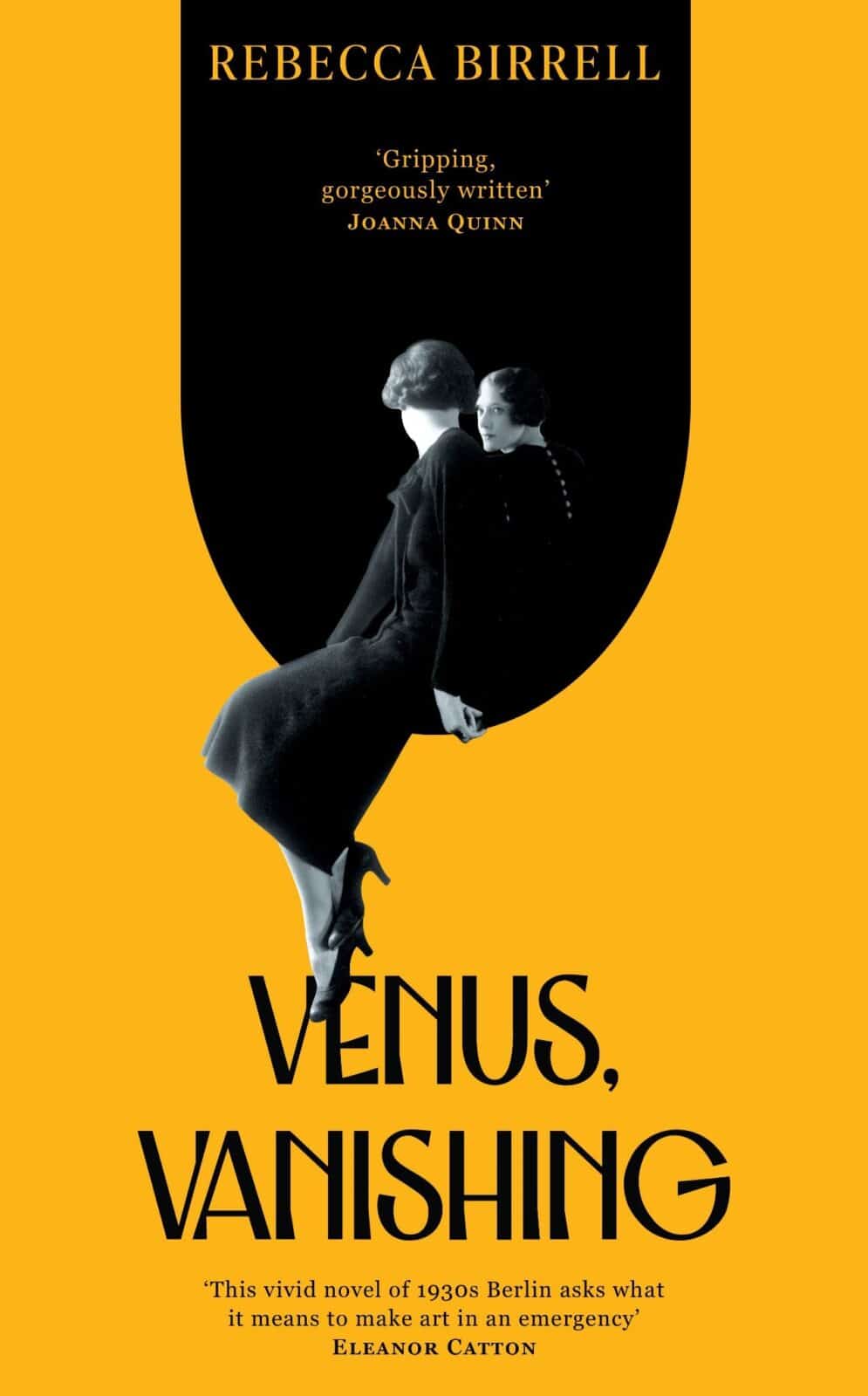
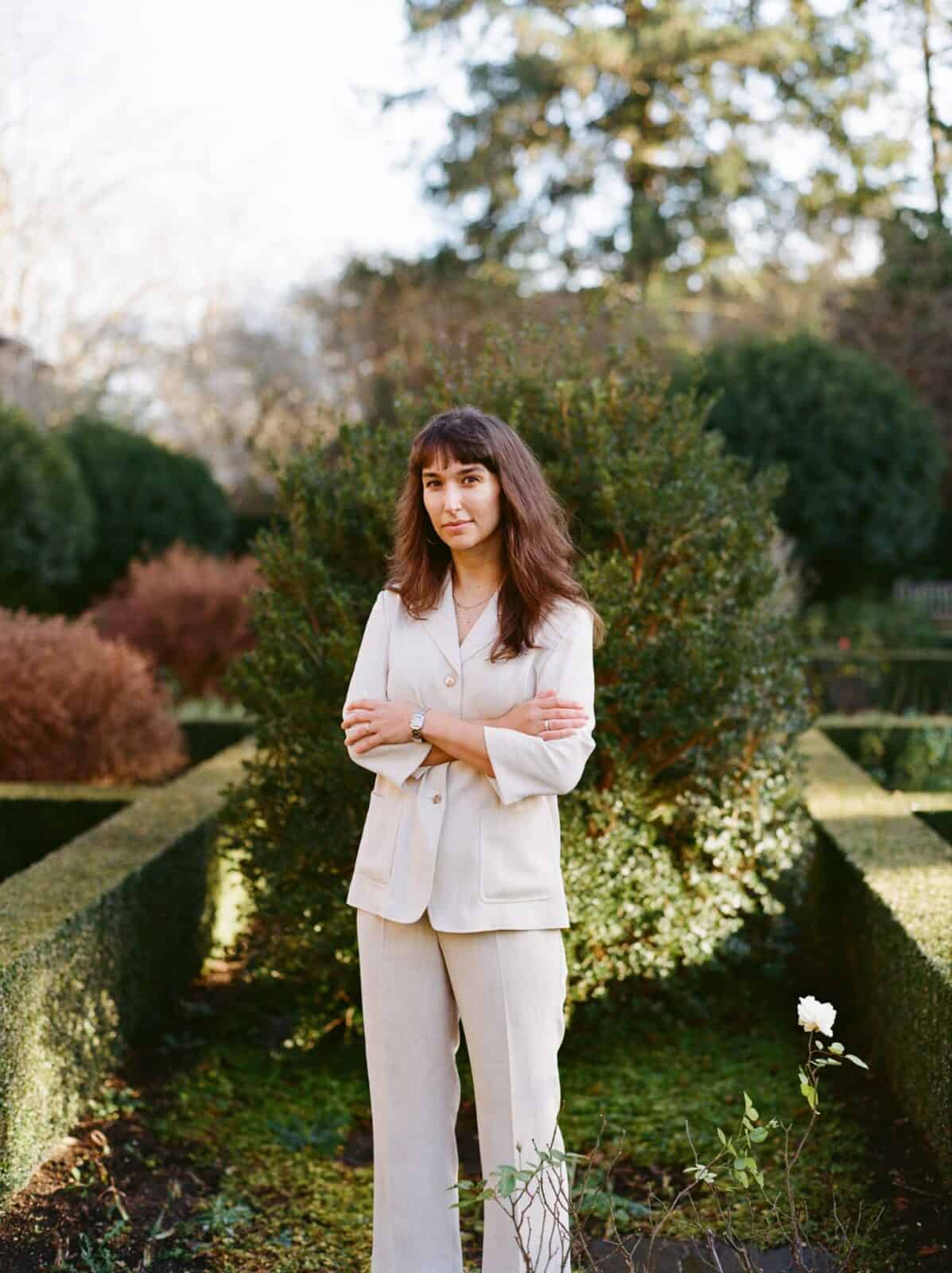
Rebecca Birrell walks into the café in canary yellow and chartreuse. As we settle in with our coffees, I feel the same spark of excitement I had when I first cracked open the golden cover of her debut novel, Venus Vanishing. I take a sip of my latte. Fascism, queerness, resistance. This is going to be interesting.
Before turning to fiction, Rebecca built a career as an art historian and curator, working at Charleston, the Jewish Museum, the British Museum, and the Fitzwilliam Museum in Cambridge. She has spent years recovering the overlooked lives of real women artists. It feels fitting, then, that her first novel centres on one of her own.
Hannah Sherman, a young Jewish artist living in the heart of Berlin, is born from years of Rebecca’s research into a generation of Jewish women artists murdered by the Third Reich: Charlotte Salomon, Chana Kowalska, Olga Oppenheimer, Nathalie Kraemer, and countless others. In Venus, Vanishing, Hannah embarks on a reckless affair with the wife of a powerful man just as her artistic career is taking off. But as the Nazi Party tightens its grip on the city, she must choose her allegiances wisely, and transform her art into a means of survival.
In my conversation with Rebecca Birrell, we explore the ethical questions raised by the Holocaust novel and what it means to write about art in a time of emergency.
The Cold Magazine (CM): Rebecca, I’m a big fan of your work as an art curator, so I was very excited to hear that you were working on a novel. How did you go from writing exhibition labels to writing Venus Vanishing?
Rebecca Birrell (RB): I suppose there are two starting points. One of them is my first book, which was nonfiction – This Dark Country: Women Artists, Still Life and Intimacy in the Early Twentieth Century (2021).
Looking back at it now, I feel it’s so much a book written by someone in their twenties. There are elements of it that are quite wild and strange
When I was touring that book, the passages I most enjoyed reading aloud were the more fictional, speculative, counter-historical sections. At the same time, I was beginning to think about another non-fiction book, this time about a group of artists murdered by the Third Reich.
As I thought more seriously about how that project would work, I realised making it entirely fiction might actually do more for the subject. I was very cautious about writing something that was simply about death.
When we think about the communities murdered in the Holocaust, we tend to think in statistics of the millions of lives lost, or through grief-laden images like the piles of shoes at Auschwitz. As a Jewish person, that’s how I encountered this history from an early age. I wanted instead to write about the expansive, vital, flourishing lives those people lived.
The second starting point came while I was at the Fitzwilliam Museum. I worked on the restitution research surrounding Gustave Courbet’s La Ronde Enfantine.
CM: Yes, the Courbet! I remember that case.
RB: Research suggested that this Courbet painting had passed through the hands of high-ranking Nazi officials, and that was very shocking. It was the first time, as a curator, that I had been so close to something like that.
Intellectually, you know that paintings are witnesses to history, but I hadn’t fully understood that idea on a deep, emotional gut level until then. Paintings carry those traces with them, and when you stand before them, you’re coming into intimate contact with that history.
What interested me was that Courbet’s work was all about rejecting the sort of stuffy idealism of academic painting. It was all about the raw sensuality of nature and carried, implicitly, I think, a kind of left-wing politics. Yet I could also see how easily these landscapes could be misappropriated to communicate a blood-and-soil ideology.
Paintings are, in effect, mute. They can be made to express things that aren’t there. And so I began to wonder: what would happen if an artist that was ideologically deemed degenerate by the Nazi regime just so happened to create work that aesthetically matched its tastes?
CM: That’s fascinating. You can really see how being a curator fed directly into the novel.
RB: Exactly. With the novel, I wanted to create a kind of museum where you could bring these lost or destroyed works of art together and stage encounters between people and paintings.
When I worked on the Fitzwilliam Museum’s rehang project in 2024, we reinterpreted over 100 paintings. I wrote new interpretation for every single one and it was all about asking, “what are the stories that are distilled into these paintings?” That question stayed with me while I was writing the novel.
CM: It’s so interesting to think about paintings as being alive in that way. I have a friend who’s an archaeologist who talks about objects almost having souls – that they carry stories and energy.
I’ve been thinking about that recently in relation to places like concentration camps. Is visiting them an act of witnessing? Or is there something else happening there?
RB: Personally, it’s something I would never do.
I’m not entirely sure what you’re learning by going somewhere like that, or what kind of witness you’re bearing. More broadly, I think I’ve become weary of the whole culture industry that has grown up around Holocaust representation.
There are so many commercial novels like The Tattooist of Auschwitz that I find deeply unsatisfying. I was on a beach recently and noticed someone reading The Tattooist of Auschwitz. I remember thinking, “This is so strange”.
I’m not convinced those books meaningfully contribute to remembrance. Many of them are full of inaccuracies and they reinforce a particular understanding of Jewish life as being defined solely by death and passivity and anonymity.
With Venus, Vanishing, I wanted to write something that was more about life and survival and resistance.
CM: As someone who isn’t Jewish, I imagine that it must feel particularly personal to constantly see Jewish lives represented primarily through suffering.
RB: Totally. I’m not sure what sense you develop about Jewish subjectivity if you’re only consuming these kinds of books. I think that they have a slightly insidious effect.
The Holocaust was an attempt to dehumanise Jewish people. I worry that some commercial fiction inadvertently continues that dehumanisation by failing to imagine rich, complicated lives beyond persecution.
That’s one reason my book has a time skip between 1938 and the 1950s. I wasn’t interested in writing scenes of suffering in that way.
CM: What was it like writing about an artist when the reader never actually sees her paintings? Were you imagining specific works as you wrote?
RB: Very much so. Around the time I began writing the novel, I became captivated by the work of Lotte Laserstein, the German-Jewish painter. She was one of the few women associated with the New Objectivity movement, and she built this incredibly bold career in a male-dominated world before fleeing Nazi Germany.
The works that were very much in my mind when I was writing were these big, spectacular nude paintings. One painting I’m thinking of in particular is this amazing nude of her lover, and she has this lithe, androgynous body. And then in the background, Laserstein has painted herself.
You know, it was an incredibly daring and transgressive thing to do. I mean, even painting the nude as a woman at that time was something that was daring.
Another important moment came when I visited Berlin in 2023 and saw her painting Evening over Potsdam. It’s this gigantic history style painting, arranged almost like The Last Supper, except it’s a group of friends, all in contemporary dress. There’s a female figure at the very center of the painting who, while everyone is chatting and looking very relaxed, she’s staring disaffectedly into the distance. And it was just something about that sense of danger on the horizon.
I wanted both to write a novel that had the feel of this painting, and that was almost written from the perspective of this mysterious female figure.
CM: This painting feels strangely contemporary as well. You look at it now and think about sitting around dinner tables in 2026, wondering whether history is beginning to repeat itself.
RB: Exactly. So often, novels about the Holocaust make fascism feel safely contained in history, as though it’s something we’re comfortably separated from, but the legacy of European fascism is still very much in the texture of our everyday life.
It was important to me to write with more urgency, and also to write about Jewish resistance, about communist organising, about the Jewish Bund, and about the possibilities people imagined for Jewish life in the diaspora.
CM: We’ve talked a lot about the ideas behind the novel, but how did Hannah herself emerge?
RB: That’s a great question. I’ve always been fascinated by the frustrated woman artist in twentieth-century fiction.
Virginia Woolf is just my absolute favourite, and I’ve always loved Lily Briscoe in To the Lighthouse. There’s something so poignant about her, but I’ve always had this desire to imagine a more reparative version of that figure – to give her more agency, more talent, more possibility.
And so Hannah was partly drawn from that. I was also interested in women’s coming-of-age stories from this era. There were books that guided me, like Elizabeth Jane Howard’s The Beautiful Visit and Shirley Hazzard’s The Bay of Noon.
I also read loads of fiction in translation that was written by German writers at the time. And most of these novels were written by men from the perspective of men, and just had this very different feel to them.
Whereas I read two novels by Irmgard Kern told from the perspective of a young, slightly frivolous, silly woman who’s living in Berlin and the texture of it was just so different. And that was what I wanted to capture with Hannah.
CM: I have to ask about the queerness of the novel. How did you develop the relationship between Hannah and Elke, as well as her relationships with Charlotte and Saul?
RB: Well I think it’s particularly hard to assert the queerness of femme presenting women. That is something that is important to me intellectually and personally.
In my first book, a lot of what I was trying to do was reframe a group of artists as queer who hadn’t really been thought of in those terms before, so it felt like a natural thing to extend that project in Venus, Vanishing with the femme-femme romance between Hannah and Elke.
I also wanted to represent different kinds of relationships coexisting. There’s a love triangle in the book, but it isn’t driven by jealousy in the conventional sense. The queerness also mattered because of the novel’s engagement with painting. The history of the nude assumes a male artist, a male spectator, and a female model. The model exists to satisfy someone else’s desire.
I wanted to ask what happens when that structure changes. Artists like Ethel Walker or Tamara de Lempicka aren’t simply producing female nudes through some mystical feminine essence. Instead, they’re consciously reinventing an artistic tradition.
In the book, Hannah is doing the same. She’s learned from that tradition, but she’s also bringing her own desires into it. Her queerness undeniably shapes the paintings she makes.
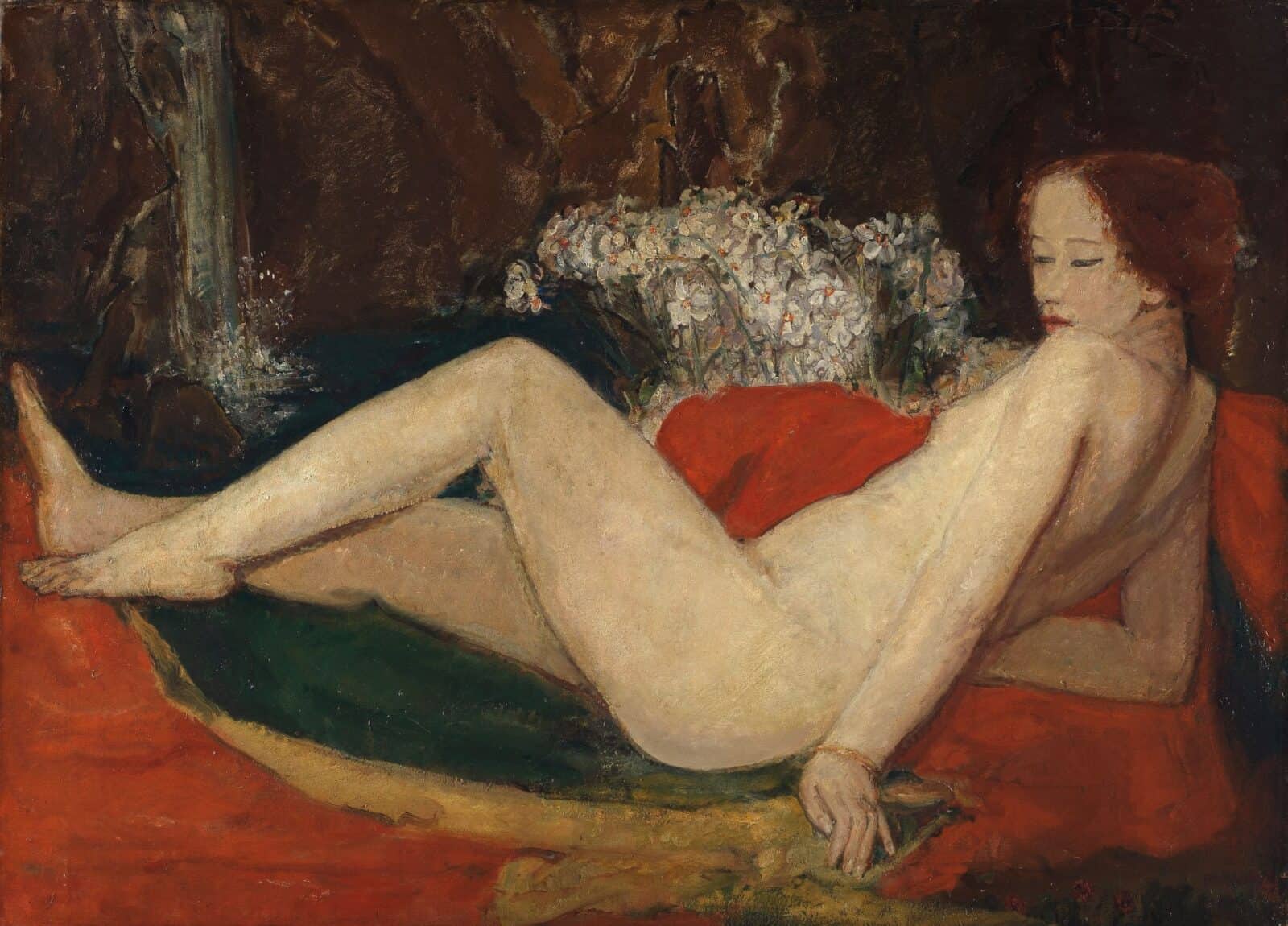
Ethel Walker, Silence of the Ravine, 1916, oil on canvas. Photo © The Fitzwilliam Museum, University of Cambridge.
CM: There’s also a really interesting class dynamic between Hannah and Elke. Historically we tend to think of working-class women modelling for money, but here, it’s the wealthy woman who’s taking her clothes off for a working-class, female artist.
RB: Exactly. I wanted to turn that power dynamic on its head. It was also important that I acknowledged the material realities of being an artist.
Money determined so much about women’s lives during this period: what work they could make, where they could live, how much freedom they possessed. That’s sometimes overlooked in sort of pop feminist accounts of women artists.
For Hannah, almost every important decision is shaped by economics. She desires Elke, but Elke also has genuine economic power over her. I became interested in what happens to the artist’s gaze when the person being painted possesses more power than the painter herself.
CM: How did you approach writing intimacy? The novel isn’t explicit, but it’s deeply sensual.
RB: That was probably one of the hardest parts, particularly because I wanted the novel to retain a historical voice. You can’t look back at novels from this period and find ready-made models for writing queer intimacy.
Virginia Woolf has always been hugely important to me and while there isn’t much sex in her novels, there’s an enormous amount of desire, and that’s what interested me. I wanted Venus, Vanishing to feel suffused with longing and sensuality, even when I wasn’t explicitly writing about sex.
CM: I’d almost describe it as a sexy novel rather than a novel about sex.
RB: I’m very happy to hear that. I’ve actually been thinking quite a lot about why writing erotically is so difficult.
I think sometimes people isolate sex from the rest of emotional life, as though you can place eroticism inside its own vacuum. I wasn’t interested in that; I wanted eros to permeate Hannah’s entire world.
CM: It feels particularly diverse at a moment when publishing is saturated with romantasy and sexually explicit fiction.
RB: It’s interesting, isn’t it? I suppose I’ve always preferred novels that write around desire rather than directly through explicit scenes.
The stories I love, particularly novels by women from the early and mid-twentieth century, often approach intimacy obliquely.
CM: Finally, and this may be much too soon, but what’s next for your writing life?
RB: I’m writing another historical novel. There’s also one shared character from Venus Vanishing, so perhaps it’s becoming a small fictional universe.
The rest you’ll have to wait and find out in time!
Rebecca Birrell’s Venus, Vanishing was published by Pan MacMillan on 16 July 2026.


