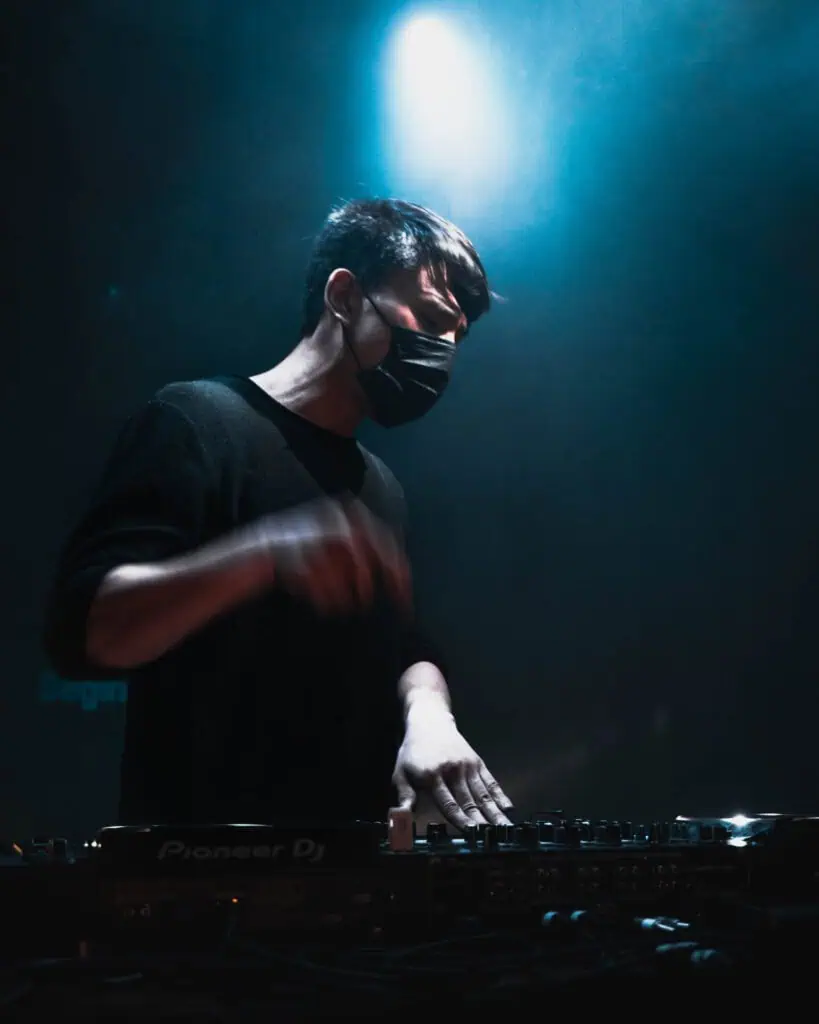
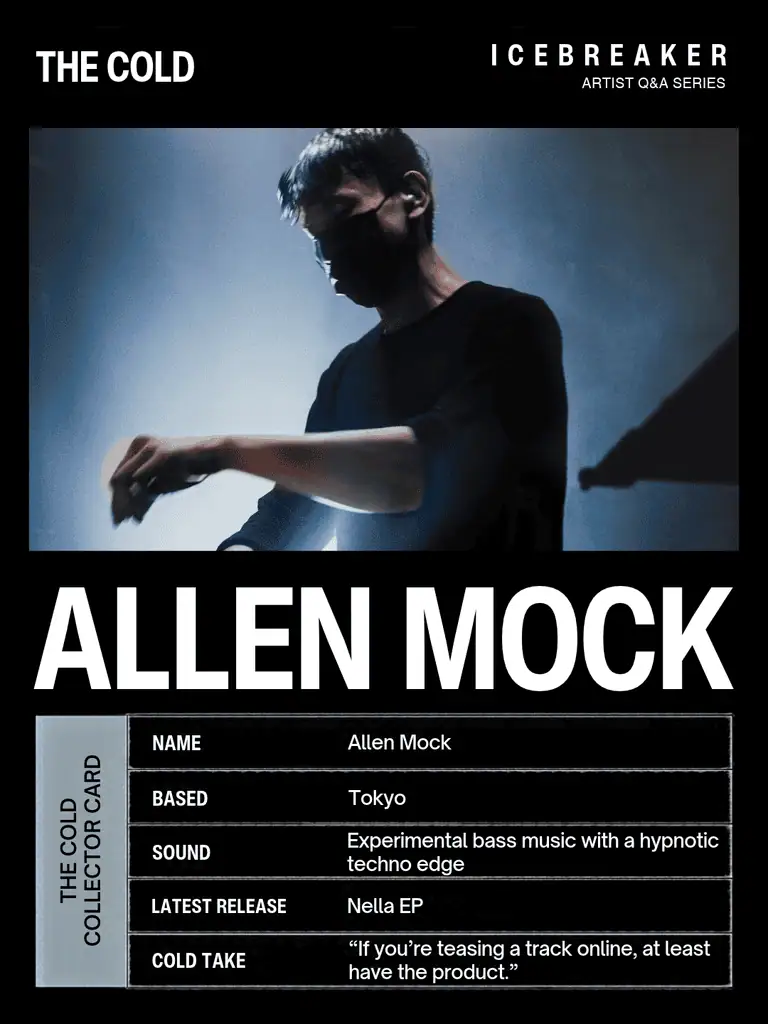
The name Allen Mock started as a joke. 10 years ago, a university student in Tokyo was weighing up the degree his dad wanted for him against the decks he couldn’t stop thinking about. He chose the decks, borrowed the name of his mum’s Korean barbecue restaurant, Araenmok, and gave it an English-sounding twist. In Korean, araenmok is the warmest spot on a traditional heated floor, closest to the fire. A decade, a debut album, and a stack of EPs later, the joke has become this former student’s identity, and a name that means “a warm place to gather” suits his music more than he could have planned.
Born in Korea and raised in Japan from before his first birthday (bar two childhood years in New York, where morning radio got him hooked on Gorillaz and 50 Cent), Allen Mock makes deep, cinematic bass music shaped by Tokyo’s hypnotic techno scene. His debut album Epoch was designed to be heard front to back or back to front. His new four-track EP Nella, out now on Polygonia’s Munich label QEONE, is his softest work yet. He mixes and masters everything himself, and spends most weekends at VENT in Omotesando, which these days feels less like a night out and more like a lesson in music.
For our first ever Icebreaker session, COLD sat down with Allen to talk about names that work backwards, the year he spent working on a single track, and why teaser clips of unreleased music drive him mad.
COLD Magazine (CM): Where does the name Allen Mock come from?
Allen Mock (AM): My mum’s side of the family own a Korean barbecue restaurant here in Tokyo called Araenmok. In Korean it means “a very warm place.” The word isn’t really used anymore, but around the Second World War era it represented a safe space where everyone could gather, when there was war, or when it was raining. I thought that was a really cool symbol, so I put my own spin on it, called myself Allen Mock and made it sound kind of English, as a joke. That was 10 years ago and now it’s a serious thing. The more music I released, the more I thought, maybe I should really keep this as my identity.
CM: Was music always the plan?
AM: Around 10 years ago, in my second or third year of university, I started having this craving to pursue music. That year was a pivotal moment because I had to decide. I could graduate, get a degree, and do what I guess my dad wanted, or follow the youthful side of me that wanted to explore something fun. I took that route.
I actually started as a DJ, but very quickly I noticed I wanted to do more than just play songs I liked. So I started remixing songs I already loved. I’d think, “could I add a little something on top here, or get rid of that part?” That became so much fun. I can’t tell you exactly when I became a producer, but it started from this genuine itch that turned into curiosity.
CM: You grew up in Japan but spent two years in New York as a kid. Did that shape the music you listen to today?
AM: I was born in Korea, but before I turned one my whole family moved, so I’ve lived in Japan for about 30 years. I’m 32 now. The other two years I lived in New York, in second and third grade. I went there to learn English, and it’s where I learned to communicate and understand the culture, but I came back loving the music. Every morning on the radio I’d hear Gorillaz and 50 Cent, songs with this ear candy element. Back then, you couldn’t just Spotify it whenever you wanted, so every morning I’d look forward to that Gorillaz song. I’m pretty sure it was “Clint Eastwood.” Oh, there it is. Oh, it’s gone.
CM: Compared to your other work, Nella feels more sentimental. Where did that softer side come from?
AM: I tend to make deeper, darker, more experimental music that isn’t for everybody, and I like exploring that uncanny area, especially with techno people. But I’m in that headspace for a very long time. I produce every day if I have time, and it’s a lot of powerful, harsh, sometimes very noisy sounds that you have to really put yourself inside to make good. At heart, I love doing it.
But Nella is sort of like Christmas. I love Halloween, I love summer, I love winter, but you’ve got to have Christmas, that month where it’s just peaceful, sentimental, almost like family. Every time I make something in that headspace it puts me back to baseline, like a normal person. If I make too much deep, dark stuff my ego becomes “I’m so dark and evil.” I like jazzier beats and sentimental sounds too, and it’s nice to tap into that side of me.
CM: So who, or what, is Nella?
AM: With those four songs in particular, I couldn’t figure out what to name them. I typed in Allen Mock, saw the word Allen and turned it backwards. It was perfect, because the direction I take with Allen is deep, dark, dangerous, and cinematic, and Nella is the opposite.
CM: Nella is a woman’s name here in the UK. Is it an alter ego?
AM: Exactly. Well, now that you say it, oh my gosh, yeah.
CM: The EP has jazz touches, lo-fi textures, and glitches. Which track was the hardest to get right?
AM: I’ll tell you the easiest one first. One of them felt like it took five minutes. It just needed to come out. “Third Place” took more than a year. I’ll be honest, listening to it, I still feel like something is missing. But I think I like it that way. Maybe that’s how it should be. If you spend too much time with anything, you start to overcomplicate it, and I did that with “Third Place” for sure.
CM: Would you say you’re a perfectionist?
AM: I love this question. I am, and I try to manipulate my mind into not thinking that way. I mix and master too, so the perfectionist side takes over. It has helped me sometimes, but overall that mindset has led me to unfavourable outcomes, like not meeting a deadline or not being able to release music, which is not good. So I try to suppress it a little, because no one’s perfect. The moment I really start to feel that, my music gets better.
CM: Epoch was designed to be played forwards or backwards. How did that concept come about?
AM: I love when an album takes you on a journey and then lets you relive that journey differently. Kendrick Lamar’s DAMN. starts off with a very aggressive intro, then progresses into something more introspective and concludes in a much more peaceful, calm ending. But listen from the last song to the first and you hear a completely different story – a story of somebody who started off calm and is now becoming angry and wants to rebel again. It’s such a beautifully thought out album, next-level storytelling sonically, and I wanted to recreate that in my own little world. Not as crazy as Kendrick, but I can tell my own story sonically.
Epoch starts off with very heavy bass music. As you progress, especially on the middle song, “Epoch,” that’s where you really feel the groove, and towards the end it becomes very danceable. Backwards, you hear a groove that turns dark and heavy. An epoch is a specific era, a turning point, so I put that song right in the middle of the album to represent the point where things start to change.
CM: How does being based in Tokyo shape your sound?
AM: The community I’m part of is very techno heavy. To be more specific, it’s hypnotic or psychedelic techno. Not warehouse techno with a huge thumping kick, but minimal, deep, progressive, with psychedelic and trance elements. Those hypnotic events have a specific sound, these glitchy, warped, synth-based textures that I think work perfectly for bass music. They go hand in hand. The only difference is the low end. Techno is mostly four to the floor, and my bass music is a lot slower, but the ear candy and textural stuff on top is the same. We’re just making a different groove out of it.
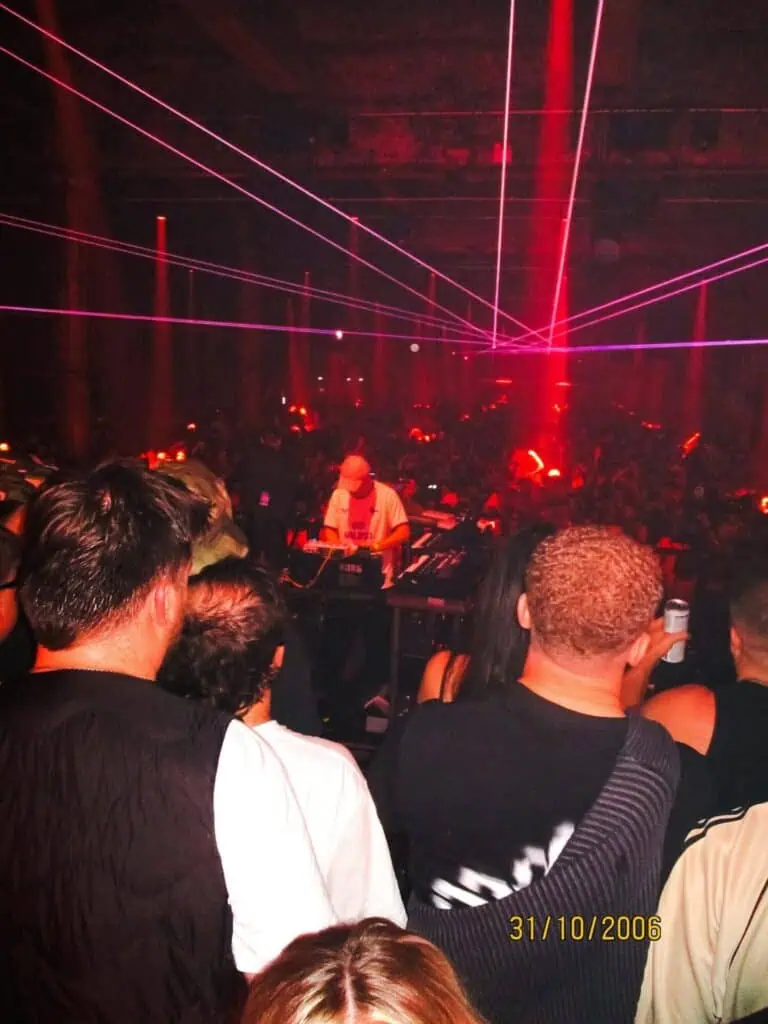
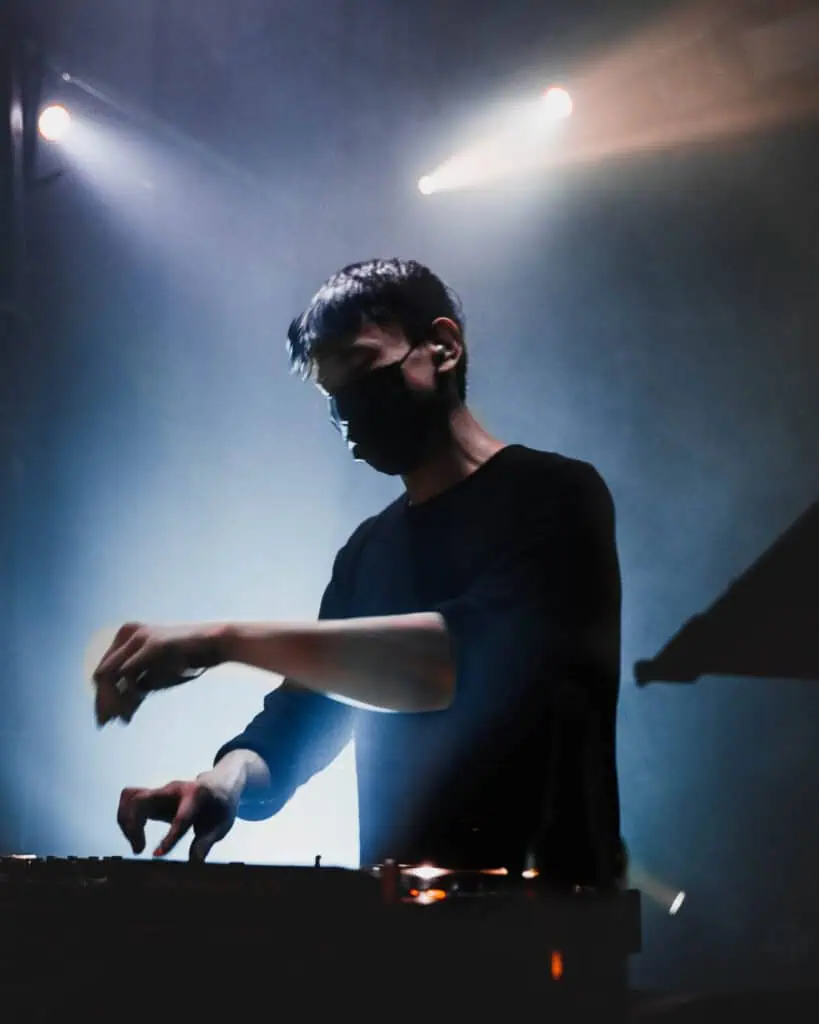
I go to VENT pretty much every weekend. It’s a super phenomenal club, and Polygonia plays there. I used to go to connect and party, but now I go to study and get inspired. Every weekend you’ll have at least two or three super methodical techno DJs giving you a five-hour lesson on why this sound is crazy. It’s helped me reinvent myself every year. I don’t like the feeling of being stuck.
CM: Give us your cold take.
AM: One thing that’s so annoying is the five-second clips. There’s so much great-sounding music online for five seconds. I get hooked, I go to the link, and they haven’t even released it. That is seriously sickening. You don’t even have the product, so why are you selling it? I get it, in a way. The algorithm is a dog-eat-dog world. But at least have the product. Beginners know one specific part of their track is really nice, so they cut it into a TikTok with all these super cool edits.
CM: Who are you listening to right now that we should Icebreak next?
Right now, definitely the Intellects. They played after me last year when I did a show in America, this phenomenal hour-and-a-half ambient set through their modular systems. I never would have guessed those glitchy sounds could turn out so beautiful. It reminded me of when I first fell in love with Aphex Twin and Squarepusher, all these intense sounds with beautiful piano and synth sounds underneath. The Intellects tap into that area, but with a modern take and their own style. They’re very smart, but also kind of goofy in a fun way. They don’t take themselves too seriously, but they’re so passionate about modular systems, sound design, and all that nerdy stuff. They totally deserve a spotlight.
Nella is out now via QEONE.
The Cold Magazine may earn a commission from some links on this page. Learn more