From James Baldwin to Irvine Welsh, novelists have long voiced protest through their characters. Cenac Rollins wants to add his name to that list.
Afua and Frank are young, Black, idealistic, and in love, until separation tears them apart. Over a stifling London summer, they scramble to make sense of their split and struggle to balance personal advancement and collective good. Afua, an artist, is intent on system change, determined to leverage her gift to build a new world. Frank, a lawyer, is resolute in achieving justice from within, using the law to effect implementable change. Though their approaches differ, they’re ambling towards an answer to a shared question: How do we realise a better society? One that works for all, is fair to all, and doesn’t require us to pull up the ladder as we climb our way through life.
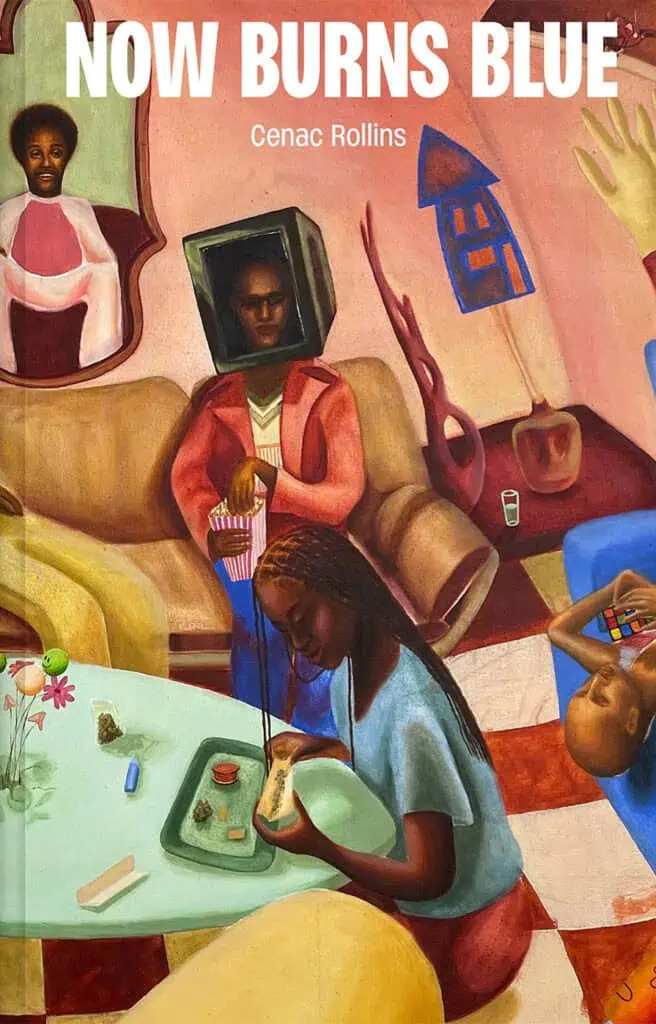
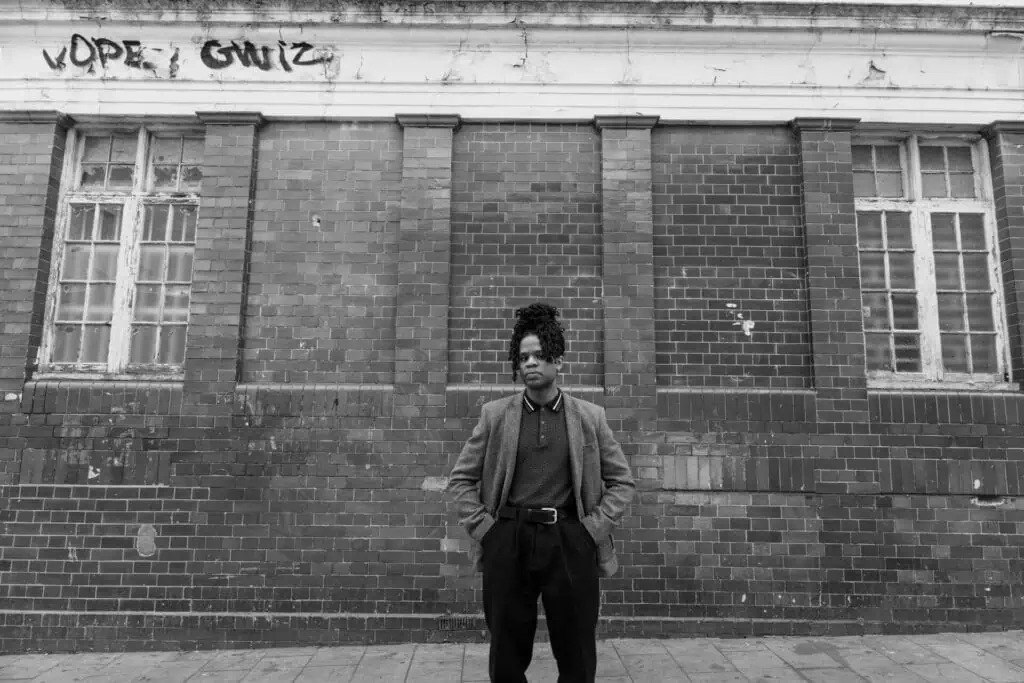
In search of an answer, they could look to Now Burns Blue, the breakout debut novel by South London lawyer, musician, and author Cenac Rollins, in which the pair are protagonists. Shifting between their dual perspectives, the novel navigates the communities, loves, and hardships they face in the wake of loss. I sat down with Rollins to discuss heartbreak, literary giants, and whether he could offer Afua and Frank any advice on how to change the world.
Now Burns Blue is a study of memory, how it bleeds into our present, and marks our future. So allow me to bend time a little, and begin at the end of our conversation. At the close, Rollins remarks, “We all exist in relation to others. Beyond the bubble of familiarity. The self is a fallacy.” Rollins understands inevitability. The inevitability of love. Its flight. And its eventual return. With that, we start our conversation in South London, where the novel begins.
“I eventually just had an image in my mind of a man on the platform at Lewisham station, baking in the sun. I then thought that I had a place for this loose narrative of thoughts I had written, and that’s how the proto-character of Frank formed,” says Rollins of the novel’s inception. He reflects further, “Then I actually started writing more about him and his people, and I was led to Afua. Because they were both characters that felt especially close to me and my experiences, South London remained the natural context.”
Rollins’s love for South London is born of familiarity and a certain intimacy with its radicalism, people, and places. “There’s such significant history here that extends beyond the confines of South, like the work of Dr Harold Moody and The League of Coloured Peoples, the Race Today Collective, the specific sites of resistance my parents witnessed, like the Brixton Uprisings in ‘81, and the Battle of Lewisham in the 1970s,” he notes.
Understanding the novel’s where, I press Rollins on its why. What pushed him to write? Was it political, personal, or something else entirely? “All of the above. I always knew I was going to write novels. But I didn’t initially have a plan when I put pen to paper for Now Burns Blue. I was driven to write by the novels I had read. I think, as with all art, writing is communication, a response to the world we persevere in.”
Following his split from Afua, Frank stumbles into a premature romance with Valeria. Herself a trainee solicitor and the daughter of a High Court Judge, she uses her connections to secure Frank an interview at a law firm, where he later becomes a paralegal. She’s well-meaning, kind, and community-minded, but the pair’s relationship is not without friction.
“[Valeria] is a character who means well and is genuine with her care for Frank and her friends. She holds the contradiction of coming from wealth but not wanting to perpetuate the ideologies behind the accumulation of that kind of wealth – while still enjoying the material privileges of her life. Her character reveals the limitations of a tendency to prioritise personal interests as a basis for political commitment.” He digresses: “Those interests of course have their place in terms of initial understanding. But they’re too flimsy.”
As Rollins elucidates his character, he draws on James Baldwin’s Another Country. Its protagonist, Rufus, is a Black musician living in 1950s France. For Baldwin, Rufus is a tool through which he can express his disdain for the enduring structural racism of French society. Through Valeria, Rollins articulates his viewpoint on the encroachment of wealth, privilege, and whiteness on historically Black parts of South London. Whilst the characters differ in several key ways, they both act as megaphones through which their creators can voice their reflections on our times.
Rollins admires “the way Another Country starts with Rufus and then, unexpectedly, becomes a narrative possessed by nuances, experiences, and complications of all the characters. I was stuck with them long after I finished the book. So I naturally tried to emulate that with the perspectives of the characters in Now Burns Blue – it was instinct by the time I was writing it.”
Armed with my understanding of the where and why of Now Burns Blue, I turn to content. Humanity is central to the story, as with any. But Black characters are often denied humanity at its fullest extent – their failures deemed unforgivable, their successes considered void. Now Burns Blue is an intentional interruption.
“Humanity is at the heart of any story,” Rollins muses. “Whether it’s a character like Frank, whose main struggle comes from self-loathing and cynicism about a world he tries to resist, or Kumi, who doesn’t even appreciate his family’s lack of means, there’s always a struggle within people. That’s what we feel first as humans. Yes, our Blackness instills cultural and social nuances in how we are, how we relate to others, and to the world. But it does not determine who we are.”
Writing the book allowed Rollins to better understand the different experiences of Blackness, but did it help him better understand himself? “It was cathartic in a way,” he says. “I was writing it during the culmination of community, different forms of love. Writing it made me really feel intimacy as a conduit for memory. This fiction is distinct from my life, but the emotions that traverse the pages have a familiar step. I guess they led me to some sense of peace,” he reflects.

Putting the personal aside, he turns his focus back outward. “Thinking in a broader sense, every breath we take in this land, with a gadget in hand, comes at a heinous cost to those in the Congo, Sudan, Gaza, and countless other places. Those people experience the kind of heartbreak where recovery feels impossible. But they defy that logic and act. I think with loss, there’s an absence; with absence comes possibility. To me, possibility means adapting to your situation, memory intact, and doing what you can with it, with others, to create what you need – it’s part of the struggle.”
Having covered the where, why, and what, we return to the end. Before closing the interview, I asked Rollins: Why the title Now Burns Blue? “The original title was About, Now Past, a nod to Toni Morrison’s Beloved – probably one of my favourite books. I was fascinated with how she treats the past as a fleshy, lingering phenomenon. How she delves into memory and rememory.”
Rollins suggested this initial title to his publisher, Somesuch Editions, a recent publishing imprint from the Somesuch production company. Unsure, they asked him to go back to the drawing board. There was only one thing to do – he drew on the sights and sounds that surrounded him, taking inspiration from Menelik Shabazz’s 1981 film Burning an Illusion and Bob Marley’s album Catch a Fire, both important cultural touchstones for Rollins. With this in mind, he wrote a poem:
“The summer breathes through us
Whilst the past simmers
Until Now Burns Blue.”
Now Burns Blue was published by Somesuch Editions on 13 July 2026.
The Cold Magazine may earn a commission from some links on this page. Learn more