I have absolute faith in the power of storytelling. My grandmother loved to tell the story of how, when I was quite young, I would come to her bedroom to have her read to me. Every time, I would leave grumbling about how I couldn’t wait to know how to read myself, so I never had to rely on others to do it for me. I have no memory of this, but what I do remember are stories, countless stories, real and imagined. Between the pages of a book there is a cornucopia of wonder: There you can escape a reality that is suffocating; you can find inspiration, joy, endless possibility. You can find the exact words to describe your very own personal demons. How casually we forget the sheer immensity of this magic.
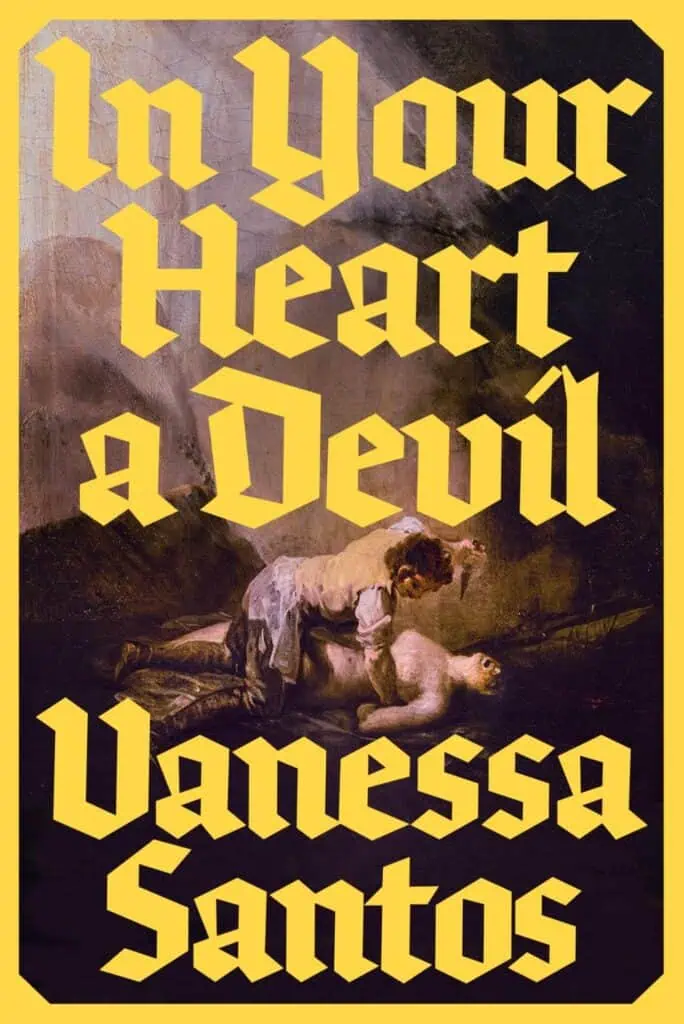
When I read, in a book of local folktales, about the Wizard Laird of Skene, there was something in me that stopped and sat up straight. I’ve loved folklore for a long time. There is something about old stories that are inescapably captivating. We have lost so much of the tradition of oral storytelling – this precious gathering around a fire to share tales – that it feels crucial to preserve our folkloric stories. The wizard’s story is actually a gathering of small tales, all centred around a man rumoured to have had dealings with the Devil, a man whose motivations are never entirely clear, but whose powers are great and frightening. What I first felt when I read the wizard’s tale was incredulity – why has no one played around with this folktale before? As time passed, I found I could not dislodge it from my mind. If there was ever a story that demanded to be told, it was this one. And so my novel In Your Heart a Devil was born, a story that shapeshifted as I worked on it, as most stories do, and became Isabel’s story – that of a woman whose life was also touched (and irrevocably changed) by this enigmatic wizard.
Jack Zippes, in Fairy Tales as Myth, Myth as Fairytale, talks about the duplication and perpetuation of stories: “We live in an age of mechanical reproduction where there are more copies of original artworks than there are originals.” That is one of the hallmarks of enduring stories, indeed a key characteristic of folktales – that they get told and retold over and over again, never quite the same way twice. In this way, they stay alive. While we have undeniably lost something precious in moving away from traditional spoken narratives, we are still telling a lot of the same stories. There is an endless supply of books on folktales, fairytales, and myths. To find a story that has been left untouched now seems rare.
That is not to say that every old story needs to be flayed on the altar of capitalism in an endless stream of repackaged fiction. There is perhaps a limit to how many versions of Beauty and the Beast we really need, and yet it is undeniable they all play a part in making sure we will never forget that fairy tale.
My wizard was once just a man, a Laird (a minor Scottish lord), who attended Satan’s school (who knew the Devil was out there teaching classes) and became proficient in the Black Arts. So proficient, in fact, that Satan wanted to keep him. Our Wizard Laird of Skene managed to escape and return to his hometown to continue with his practices. That did not end their relationship, though. The most well-known of his mischiefs involves the wizard and the Devil crossing a frozen loch on Halloween night. The coachman, contrary to his instructions, looked behind him and saw Satan’s hoofed feet, which caused the ice to crack beneath them. They all lived (except a couple of the wizard’s hounds), but it is said that, on cold nights, when the loch is frozen, you can still see the tracks on the ice.
The wizard’s last moments also involved the Devil, who came back to him when he was on his deathbed, wanting his soul. The two struck a bargain so that their familiars, a magpie and a raven, fought for the wizard’s soul. The wizard’s magpie won, and his soul presumably escaped the Devil’s grip.
Threaded together, these stories told me one obvious fact: Satan was very taken with this mortal man. He fought to have him, not once, but twice. This incredibly powerful entity that casts such a long shadow onto our world, outgrowing his own Christian mythology, is, let’s face it, a little bit obsessed with this guy. Grace Banks and Sheena Blackhill, the writers of Aberdeenshire Folk Tales where I read about the Wizard, call Satan “His Imperial Blackness,” a nomenclature that helps me illustrate how large he looms in the cultural landscape.
Satan, Christianity’s Enemy, the root of all evil. Instead of tormenting souls in hell (or whatever he does during his day job), the Devil is busy trying to convince, coerce, or win our wizard. His soul, his company, his powers, perhaps. But something about this spell-caster has caught the attention of the highest of the practitioners of the Black Arts, and he refuses to let go. Who is this man and what makes him so infinitely compelling?
His name was Alexander Skene. He was the 16th Laird of Skene, and in real life he was married with children. None of them feature in the tales told about him, long after he passed. When you look him up, it is hard to disentangle the man who is just a name on family records and the myth he became, the wizard without a shadow. I could find no information on when one fully became the other. In any case, none of his family members makes it into the stories. Alexander is alone in riding with Satan across the lake, alone when he curses the dancers at a ceilidh to dance until they could dance no more, alone when he paralysed people with one look. Where was his wife in all of this?

Perhaps at home, where women have been consigned, in stories and otherwise, since time immemorial. Forgotten in a corner tending to her children. Maybe, if we take the stories as truth, she would be frightened out of her mind by the things her husband did in the dark, his spells, his bird familiars twittering around him. Or maybe she was exasperated and wished for a husband with less eccentric hobbies.
We will never know. Her life never made it into folklore. When I started writing In Your Heart a Devil, I was not thinking of giving this woman, who was real and had an inner life we can never conceive of, a seat at the table. Isabel is not Giles Aedie, born in 1674. It would feel wrong and frankly disrespectful to try to imagine who she was. Which is why I gave Alexander a whole new wife – she is an immigrant, alone and isolated, and desperate to attach herself to someone else.
While I loved the tale of the wizard and wanted to play with it, it was exactly what I wished for: To play. By fictionalising the real people behind the wizard’s tale and keeping their names from the narrative, I put on a safety cloak. This is the storyteller’s ultimate prerogative, and a sacred one at that: Ultimate freedom on the page. Alexander is only a character in Isabel’s story – he haunts the pages of her book, much like Rebecca haunts the pages and life of the new Mrs. de Winter in Daphne du Maurier’s Rebecca. Much like stories haunt each other, ghosts peek from between the sentences. We carry all our grief with us; it would be foolish to expect our fiction not to be cemeteries full of spectres.
There is a sense of responsibility in picking up a tale that belongs to the land and to its people. I would not do it if I did not firmly believe that this is how we keep stories alive – and that keeping stories alive should be a shared responsibility. We should all want to hold on to our stories as much as we can, as tightly as we can, so they don’t fall into the cracks of time. There is power in stories – we should tread carefully, respectfully. But may we never fear to tread nonetheless, wander into every forest of words and gently place our hands against the tree trunks, feel the moss beneath our feet, listen carefully for the faint echoes of others long gone whispering to the wind: Once upon a time…
Vanessa Santos’s In Your Heart a Devil was published by Dead Ink Press on 8 October 2026.